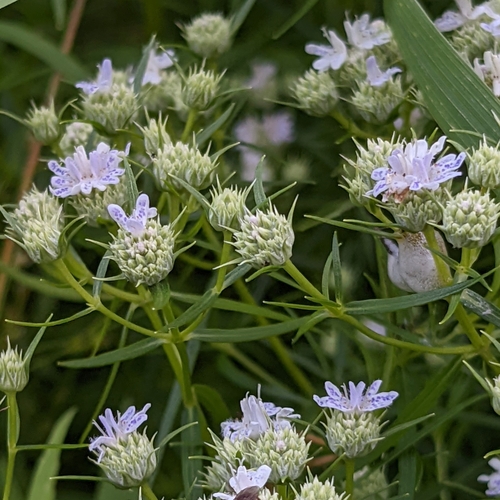
narrowleaf mountainmint
Pycnanthemum tenuifolium
A midsummer magnet for pollinators, narrowleaf mountainmint creates a 'snow-covered' effect in the garden with its prolific white blooms. Its needle-thin foliage and minty fragrance make it as beautiful as it is ecologically vital.
Quick Identification
Size
2–3 feet (60–90 cm) tall; 1–2 feet (30–60 cm) spread
Colors
Bright white flower clusters with occasional tiny purple spotting; stems are pale green to reddish; foliage is a deep, vibrant green.
Key Features
- Extremely narrow, needle-like leaves without teeth
- Flat-topped clusters (cymes) of small white flowers
- Square-shaped stems typical of the mint family
- Strong medicinal or minty scent when leaves are crushed
- Dense, bushy growth habit with multi-branched stems
When You’ll See Them
Behavior
Narrowleaf mountainmint is a hardy, clump-forming perennial that serves as one of the most productive nectar sources in the eastern North American landscape. Unlike some of its more aggressive mint cousins, it spreads slowly via rhizomes, forming tidy but dense bushes that provide excellent cover for small ground-dwelling creatures. During its long blooming period in mid-to-late summer, the plant becomes a buzzing hub of activity, often covered in dozens of species of insects simultaneously.
This species is highly resilient and drought-tolerant once established, making it a reliable performer in backyard habitats. It does not require staking despite its height, as its woody-based stems are quite sturdy. For humans, it offers a sensory delight; brushing against the foliage releases a refreshing, clean aroma that is often described as a mix of spearmint and thyme.
EverydayEarth exclusive
Camera Tips
To capture the incredible biodiversity that narrowleaf mountainmint attracts, position your camera on a tripod or stake roughly 2 to 3 feet away from the flower heads. Because the flowers are flat-topped, an overhead or 45-degree downward angle works best to see the insects landing on the 'landing pads' of the blooms. If your camera has a macro or close-focus setting, this is the time to use it, as many of the visiting pollinators like native bees and hairstreak butterflies are quite small.
Lighting is crucial when photographing this plant. The bright white flowers can easily 'blow out' or lose detail in harsh midday sun. Aim to capture footage during the 'Golden Hour'—shortly after sunrise or before sunset—when the light is softer. If you are using a trigger-based trail camera, set the PIR sensitivity to 'High' to detect the fast movements of visiting wasps and butterflies, and use a short trigger interval to capture the sequential movement of insects from flower to flower.
For a unique perspective, try a time-lapse setting over a 4-hour window on a calm, sunny day. This will reveal the constant 'musical chairs' of pollinators competing for nectar. Avoid days with high wind, as the slender stems of the mountainmint will sway significantly, likely resulting in blurry images or constant false triggers on your device. If your camera allows for manual shutter speed, aim for at least 1/500th of a second to freeze the wings of visiting pollinators.
Similar Species
Species that look similar or are commonly confused with narrowleaf mountainmint.
Frequently Asked Questions
Record narrowleaf mountainmint at your habitat
Connect a camera to start building your own species record — AI identifies every visitor automatically.