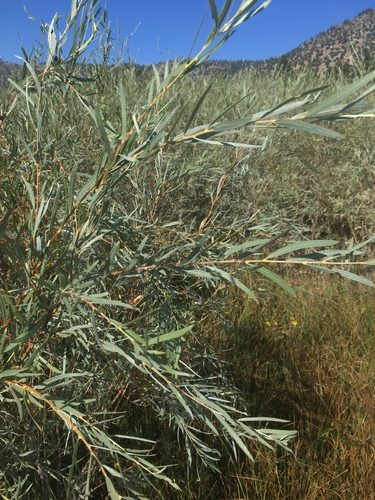
Narrowleaf Willow
Salix exigua
The Narrowleaf Willow is a shimmering, silver-green powerhouse of the wetlands, creating dense sanctuary thickets for birds and mammals alike. Its presence transforms a simple damp corner of a yard into a bustling wildlife corridor.
Quick Identification
Size
A multi-stemmed shrub or small tree typically reaching 2-5 meters (6-16 feet) in height, occasionally up to 8 meters (26 feet), with a spread of 3-4 meters (10-13 feet).
Colors
Silvery-gray to grayish-green foliage with fine, silky white hairs; bark varies from reddish-brown to smooth gray; yellow to pale green catkins.
Key Features
- Extremely narrow, linear leaves about 10 times longer than they are wide
- Silvery pubescence (fine hairs) on both leaf surfaces giving a shimmering look
- Forms dense, clonal thickets through underground rhizomes
- Small, widely spaced teeth along the leaf margins
When You’ll See Them
Behavior
The Narrowleaf Willow, also known as the Sandbar Willow, is a pioneer species characterized by its remarkable ability to colonize disturbed riparian areas. Unlike many other trees, it spreads primarily through an extensive network of underground rhizomes, creating dense thickets that serve as essential corridors for wildlife movement. In the backyard or wild space, it acts as a 'soil stabilizer,' holding creek banks together during heavy rains.
This species is highly resilient and exhibits a 'fast-growth' life strategy. It is one of the first plants to leaf out in the spring, providing an early source of nectar for pollinators and cover for nesting birds. While it is considered common in most of North America, it plays a vital ecological role in the East, where it is listed as threatened or endangered in states like Massachusetts and Connecticut due to habitat loss.
EverydayEarth exclusive
Camera Tips
Capturing the Narrowleaf Willow effectively on a trail camera requires understanding its role as a 'wildlife magnet.' Because these willows form dense thickets, they create natural funnels for animal movement. Position your camera at the edge of a willow stand, roughly 18-24 inches off the ground, to capture the 'tunnel' entrances where small mammals like rabbits and woodchucks enter for cover. If you are near a water source, aim the camera at the base of the willow to catch beavers or muskrats, who frequently harvest the tender reddish-brown bark during the night.
One of the unique challenges with this species is its movement. The long, slender branches of the Narrowleaf Willow sway significantly even in light breezes, which can trigger a motion-sensor camera thousands of times, draining the battery. To avoid this, set your camera to 'High' trigger speed but 'Medium' or 'Low' sensitivity. Alternatively, use the willow as a beautiful, shimmering backdrop by placing your camera on a sturdy post or a different tree species facing the willow, ensuring the sun is behind the camera to highlight the silvery leaves.
During the spring bloom, the yellow catkins attract a dizzying array of pollinators and insectivorous birds. This is the perfect time to use a 'time-lapse' mode rather than motion detection. Set your camera to take a photo every 5-10 minutes during daylight hours. This will allow you to document the transition from bud to flower and capture the various songbirds, such as yellow warblers, that flit through the branches looking for insects.
In winter, the Narrowleaf Willow remains a focal point for herbivores. As other food sources vanish, the willow's twigs become a primary food source for deer and elk. Place your camera near the willow thicket during the first snows, using a slightly higher angle (4-5 feet) tilted downwards. This will capture the browsing behavior of larger mammals without the camera being buried or obscured by low-hanging, snow-laden branches.
Similar Species
Species that look similar or are commonly confused with Narrowleaf Willow.
Frequently Asked Questions
Record Narrowleaf Willow at your habitat
Connect a camera to start building your own species record — AI identifies every visitor automatically.