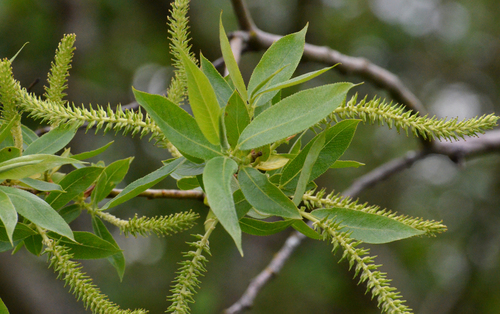
Pacific Willow
Salix lasiandra
The Pacific Willow is a shimmering giant of the wetlands, recognized by its lustrous green leaves and vibrant reddish twigs. As a cornerstone of the riparian ecosystem, it provides essential food and shelter for everything from tiny pollinators to large mammals.
Quick Identification
Size
Height: 15-60 ft (4.5-18 m); Trunk diameter: 1-2 ft (30-60 cm)
Colors
Lustrous dark green upper leaves, pale or glaucous undersides; twigs range from bright yellow to deep reddish-brown; yellow catkins.
Key Features
- Shiny, lance-shaped leaves with finely serrated edges
- Small warty glands located at the base of the leaf blade
- Long, flexible 'whiplash' twigs that are often reddish or yellow
- One of the largest willow species, often growing as a distinct tree rather than a shrub
When You’ll See Them
Behavior
The Pacific Willow is a fast-growing, water-loving pioneer species that plays a critical role in stabilizing riverbanks and wetland ecosystems. While it doesn't move like an animal, its 'behavior' is defined by its rapid growth and its ability to regenerate from broken branches that lodge in muddy banks. It is often the first tree to produce foliage and flowers in the spring, making it a vital early-season resource for local fauna.
Ecologically, this willow acts as a community hub. Its early-blooming yellow catkins provide an essential source of nectar and pollen for native bees and emerging butterflies when other food sources are scarce. For humans, it is a hallmark of a healthy riparian zone, providing deep shade and a natural windbreak in moist environments.
EverydayEarth exclusive
Camera Tips
When targeting a Pacific Willow with your AI camera, your goal isn't just to photograph the tree, but the incredible diversity of wildlife it attracts. Because these trees grow in moist, riparian zones, they are natural 'highway' markers for mammals. Mount your camera on a sturdy branch or a nearby trunk about 3-4 feet off the ground, angled toward the base of the willow or the water's edge. This is a prime spot for capturing thirsty deer, elk, or even elusive predators like bobcats that follow prey to the water.
One of the biggest challenges with willows is their flexible, 'whiplash' twigs. In even a light breeze, these thin branches can sway and trigger hundreds of 'false' motion events. To avoid this, clear any small, dangling branches within 6 feet of the lens or increase the motion sensitivity threshold on your camera. For the best visual results, position the camera so it faces away from the sun; the Pacific Willow's leaves are exceptionally shiny and can cause heavy glare or 'white-out' on your images if the sun reflects directly off them into the lens.
For bird enthusiasts, the Pacific Willow is a goldmine in late spring (April-May). Its catkins attract a variety of warblers, hummingbirds, and flycatchers. If your camera has a 'time-lapse' or 'burst' mode, set it to trigger frequently during the morning hours. If you can safely mount a camera higher up (around 8-10 feet) facing a cluster of flowering catkins, you’ll capture the frantic activity of pollinators and the birds that feed on them. Because these areas are often humid, always use a fresh desiccant pack inside your camera housing to prevent the lens from fogging in the damp morning air.
Similar Species
Species that look similar or are commonly confused with Pacific Willow.
Scouler's Willow
Scouler's Willow prefers drier soils and has broader leaves that are widest near the tip, rather than lance-shaped.
Shining Willow
The Shining Willow (Salix lucida ssp. lucida) is very similar but is typically found in eastern North America, whereas the Pacific Willow is the western variant.
Arroyo Willow
Arroyo Willow has much narrower, duller leaves and generally stays as a multi-stemmed shrub rather than a tall tree.
Frequently Asked Questions
Record Pacific Willow at your habitat
Connect a camera to start building your own species record — AI identifies every visitor automatically.