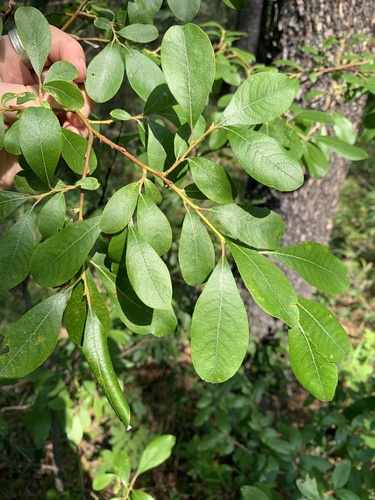
Scouler's willow
Salix scouleriana
The ultimate survivor of the western landscape, Scouler's willow is more than just a tree—it is a bustling hub for early-spring pollinators and a preferred snack for woodland giants.
Quick Identification
Size
A large shrub or small tree reaching 2–15 m (6–50 ft) in height with a trunk diameter up to 40 cm (16 in)
Colors
Dark green, shiny upper leaf surfaces; pale, glaucous, and often hairy undersides; dark gray to brownish fissured bark
Key Features
- Leaves are wider at the tip than the base (oblanceolate/spatulate)
- Fuzzy, silver-white catkins appear before leaves in early spring
- Diamond-shaped patterns often visible on younger bark
- Commonly grows with multiple stems from a single base
When You’ll See Them
Behavior
Scouler's willow is a resilient pioneer species, often the first to colonize areas after a forest fire or major soil disturbance, which earned it the nickname 'fire willow.' Unlike many other willows that require constant standing water, this species is remarkably drought-tolerant and can be found on upland slopes and in drier forest openings, though it still thrives near wetlands and stream banks.
In the backyard ecosystem, this willow acts as a vital early-season resource. It is one of the first plants to bloom in late winter or early spring, providing essential nectar and pollen for emerging bees and hummingbirds when few other food sources are available. Its dense, multi-stemmed growth habit also provides excellent nesting cover for songbirds and hiding spots for small mammals.
EverydayEarth exclusive
Camera Tips
To capture the best wildlife action on Scouler's willow, focus your camera on the 'pussy willow' catkins during the very early spring. This is a high-traffic zone for pollinators and rufous hummingbirds. Use a camera with a fast trigger speed and a macro or close-focus setting, mounting it about 3-5 feet away from a cluster of blooms to catch the rapid movement of insects and birds.
Because this willow is a favorite browse for ungulates like deer and elk, position a second trail camera about 10-15 feet back from the tree, aimed at the lower branches (approx. 3-4 feet off the ground). If the willow is located near a water source or a forest edge, you are likely to capture deer 'pruning' the new growth during the twilight hours. Use a wide-angle lens if possible to capture the scale of the visiting animals.
Don't ignore the trunk! The rough, fissured bark of older Scouler's willows attracts nuthatches, creepers, and woodpeckers looking for insects hiding in the crevices. Mounting a camera vertically on a neighboring tree or post, aimed directly at the willow's main trunk at eye level, can reveal a hidden world of climbing birds and squirrels that often go unnoticed from a distance.
During the winter, Scouler's willow stands out against the snow or bare forest. This is an excellent time to use a time-lapse setting to document how the buds swell and eventually burst into fuzzy catkins. Since the tree doesn't move much except in high winds, you can use lower sensitivity settings for your motion sensor to avoid 'false triggers' from blowing branches while still capturing larger animals passing by.
Similar Species
Species that look similar or are commonly confused with Scouler's willow.
Frequently Asked Questions
Record Scouler's willow at your habitat
Connect a camera to start building your own species record — AI identifies every visitor automatically.