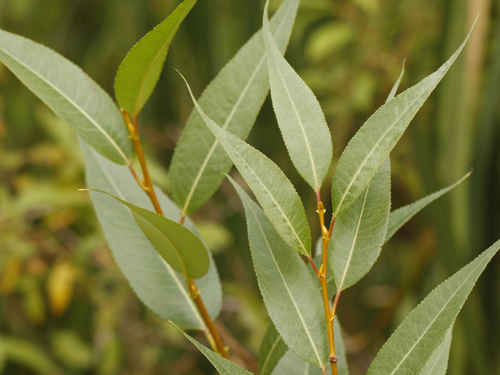
shining willow
Salix lucida
The shining willow is a shimmering jewel of the wetlands, easily recognized by its 'lacquered' leaves that catch the light. A magnet for songbirds and pollinators, this fast-growing tree turns any moist corner of your yard into a high-traffic wildlife hub.
Quick Identification
Size
Typically 4–10 m (13–33 ft) tall, though some specimens can reach up to 13 m (43 ft) with a multi-stemmed habit.
Colors
Glossy dark green upper leaf surfaces, pale green undersides, and yellowish-green spring catkins; young twigs are reddish-brown or yellow-brown.
Key Features
- Long-pointed, lance-shaped leaves with a highly reflective, 'lacquered' finish
- Small, warty glands located at the base of the leaf blade where it meets the stalk
- Flexible, whip-like branches that lack the drooping habit of weeping willows
When You’ll See Them
Behavior
The shining willow is a fast-growing, moisture-loving deciduous species that acts as a cornerstone for healthy wetland ecosystems. Unlike some trees that stand solitary, the shining willow often grows in dense, multi-stemmed thickets. This growth pattern creates an architectural 'nursery' for wildlife, providing essential nesting sites for songbirds and thermal cover for small mammals during harsh weather.
In the spring, the tree 'wakes up' with a burst of yellow-green catkins that provide one of the season's first sources of nectar for native bees and emerging insects. Throughout the summer, its dense canopy transpires large amounts of water, cooling the immediate microclimate around stream banks and ponds. For humans, it is a resilient landscape feature that stabilizes soil and prevents erosion in soggy areas of the yard.
EverydayEarth exclusive
Camera Tips
To capture the best activity around a shining willow, position your camera 3 to 5 feet off the ground, aiming at the lower branch structure or the transition zone between the tree and the water's edge. Because the leaves of the shining willow are exceptionally glossy, they can reflect sunlight and trigger your camera or cause 'white-out' glare in photos. To avoid this, face your camera North or South to ensure the sun is never directly reflecting off the foliage into the lens.
During the spring 'bud-burst' (typically April or May), focus your camera on the catkins. This is a high-traffic period for hummingbirds and insect-eating birds like warblers. Use a high shutter speed if your camera allows it, as the 'whiplash' branches move significantly even in light breezes. This movement can sometimes cause 'false triggers,' so you may need to turn down the PIR sensitivity slightly or prune a few small, foreground twigs that are directly in front of the sensor.
In the winter, the shining willow remains an excellent camera site because its reddish-brown bark provides a striking contrast against white snow. This is the best time to capture larger herbivores like deer or elk, which are drawn to the willow to browse on the nutrient-dense dormant buds. Position the camera along a known game trail that leads toward the willow thicket for the best results.
If you are using an AI-powered camera like those featured on EverydayEarth, the shining willow's dense structure is perfect for capturing 'perch-and-pounce' behaviors. Birds will often sit on the outer branches of the willow to scout for insects over the water before diving. Set your camera to 'Video Mode' with a 10-15 second duration to capture these fascinating hunting displays.
Similar Species
Species that look similar or are commonly confused with shining willow.
Frequently Asked Questions
Record shining willow at your habitat
Connect a camera to start building your own species record — AI identifies every visitor automatically.