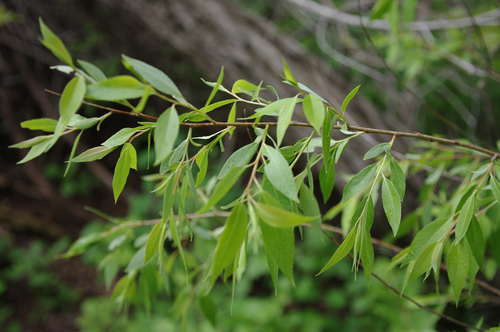
peachleaf willow
Salix amygdaloides
A majestic sentinel of North American waterways, the peachleaf willow is more than just a tree—it is a thriving ecosystem. With its elegant, shimmering foliage and deeply textured bark, it provides the perfect backdrop for discovering the secret lives of riparian wildlife.
Quick Identification
Size
Typically 10-20 meters (33-65 feet) in height with a trunk diameter of 30-100 cm (12-40 inches).
Colors
Yellowish-green foliage with pale or glaucous undersides; bark is dark brown to reddish-gray and deeply furrowed.
Key Features
- Lance-shaped leaves 5-14 cm long resembling peach leaves
- Finely serrated leaf margins with small glands at the base
- Yellowish, flexible twigs that lack 'brittleness' at the base
- Usually grows with a single, leaning trunk rather than a multi-stemmed shrub form
When You’ll See Them
Behavior
The peachleaf willow is a hardy, fast-growing deciduous tree that plays a vital role in stabilizing riverbanks and providing structural complexity to wetland ecosystems. Unlike many other willow species that maintain a shrub-like appearance, the peachleaf willow typically grows as a distinct tree, often with a leaning or slightly crooked trunk that creates a picturesque silhouette over water features.
Ecologically, it serves as a massive 'wildlife hotel.' In the spring, its catkins provide an early nectar source for emerging pollinators, while throughout the summer, its dense canopy offers nesting sites for riparian birds and cover for small mammals. It is a preferred host plant for several butterfly species, including the Viceroy and Mourning Cloak.
EverydayEarth exclusive
Camera Tips
When using an AI-powered camera to monitor a peachleaf willow, the tree itself becomes a stationary 'hub' for wildlife activity. Position your camera about 5-8 feet up a neighboring tree or on a sturdy post, angled slightly downward to capture the area where the trunk meets the water or ground. This 'root zone' is a high-traffic area for semi-aquatic mammals like beavers, muskrats, and minks that use the tree for cover or food.
To capture the incredible variety of birds attracted to the willow, try a 'canopy-view' placement if you have a high deck or balcony nearby. The peachleaf willow is a magnet for warblers and vireos during migration. Set your camera to a high-shutter speed or 'burst mode' to catch these fast-moving insectivores as they glean bugs from the leaves. Early morning light (6-8 AM) provides the best contrast for the silvery undersides of the leaves, which can help the AI distinguish the species from other nearby greenery.
For time-lapse enthusiasts, the peachleaf willow is a perfect subject. Set your camera to take one photo every day at noon from early spring through late autumn. This will document the dramatic transition from the fuzzy, yellow catkins of spring to the lush green 'peach-like' leaves of summer, and finally the golden-yellow hues of fall. Ensure the camera is securely mounted, as these trees often grow in windy, open riparian corridors where camera shake can blur fine leaf details.
Don't forget the winter utility of this tree. Even without leaves, the furrowed bark and leaning structure are attractive to woodpeckers and nuthatches. If you are targeting these species, focus your lens on the main trunk. Avoid using heavy artificial lures directly on the bark; instead, let the natural activity of the tree attract subjects. If the tree is on your property, a nearby water dripper can increase the frequency of visitors to the 'stage' set by the willow's low-hanging branches.
Similar Species
Species that look similar or are commonly confused with peachleaf willow.
Black Willow
Black willow leaves are green on both sides, whereas peachleaf willow leaves have a distinct pale or silvery underside.
Crack Willow
Crack willow twigs snap very easily at the base with an audible 'pop,' while peachleaf willow twigs are more flexible and persistent.
Shining Willow
Shining willow leaves are noticeably glossier and typically have more prominent glands on the leaf stalks than the peachleaf willow.
Frequently Asked Questions
Record peachleaf willow at your habitat
Connect a camera to start building your own species record — AI identifies every visitor automatically.