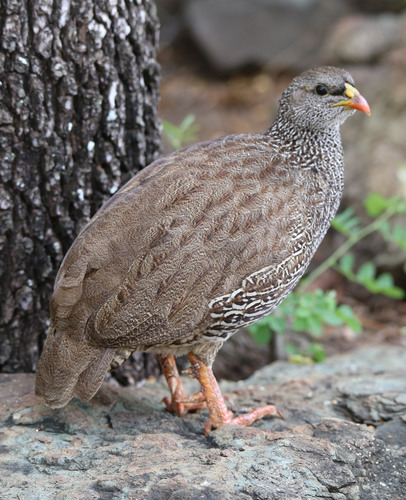
Natal Spurfowl
Pternistis natalensis
Recognizable by its vibrant red legs and raucous morning call, the Natal Spurfowl is a spirited addition to any Southern African backyard. A master of the undergrowth, this ground-dwelling bird brings character and a touch of the wild to suburban spaces.
Quick Identification
Size
30-38 cm (12-15 inches) in length; weighs between 370-720g (0.8-1.6 lbs)
Colors
Intricately mottled grey and brown upperparts; underparts are heavily barred with black and white scales. Features a distinctive bright orange-red bill and legs.
Key Features
- Bright orange-red bill and legs
- Intricate grey-brown mottled plumage with scaly belly patterns
- Unfeathered dark skin patch around the eyes
- Stout, ground-dwelling build with short wings
When You’ll See Them
Geographic range
Where Does the Natal Spurfowl Live?
This bird is a native resident of Southern Africa, thriving across a wide sweep of the sub-continent. Its core population is found throughout eastern and northern South Africa, extending northwards into Zimbabwe, Mozambique, and eastern Botswana, with smaller populations reaching into southern Zambia. Unlike many other species, it is not migratory and maintains the same territory year-round as long as water and cover are available.
Basemap © OpenStreetMap contributors
Behavior
Socially, these birds are typically found in pairs or small family coveys. They are shy in the wild but have adapted remarkably well to suburban environments, where they can become quite bold around humans if not harassed. At night, they leave the ground to roost in the safety of trees or thick bushes to avoid nocturnal predators like caracals or honey badgers.
EverydayEarth exclusive
Camera Tips
Baiting is highly effective for this species. A small scattering of wild bird seed, cracked corn, or even mealworms in front of the lens will keep them stationary long enough for high-quality captures. Because they move with a quick, jerky gait, set your camera to a fast trigger speed and a high frame rate for video to avoid motion blur. If your camera has a 'burst' mode, set it to take 3-5 photos per trigger, as they often travel in pairs and this helps capture the entire family group.
Water is another fantastic lure, especially during the dry winter months. A shallow ground-level birdbath placed near thick cover will attract them for both drinking and bathing. Position your camera about 2 meters away from the water source to ensure the wide-angle lens captures the full bird. Since they are most active during the low-light hours of dawn and dusk, cameras with superior low-light sensors or high-quality IR flash will produce much clearer results during their peak activity times.
Similar Species
Species that look similar or are commonly confused with Natal Spurfowl.
Frequently Asked Questions
Record Natal Spurfowl at your habitat
Connect a camera to start building your own species record — AI identifies every visitor automatically.