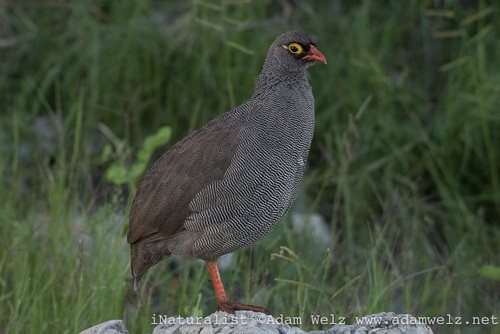
Red-billed Spurfowl
Pternistis adspersus
With its striking crimson beak and signature yellow eyes, the Red-billed Spurfowl is the vocal soul of the Southern African bushveld. Whether scurrying through garden thickets or calling from a termite mound, this charismatic ground-bird is a favorite for backyard observers.
Quick Identification
Size
Length: 33-38 cm (13-15 in); Weight: 340-635 g (0.7-1.4 lbs)
Colors
Finely barred grey-brown body; bright red bill and bare skin around the eyes; dark red to blackish legs. Male and female plumage is identical.
Key Features
- Bright red bill and featherless red eye-patch
- Striking yellow iris (unique among spurfowls)
- Finely barred, charcoal-grey and white plumage
- Males possess sharp spurs on the back of the legs
When You’ll See Them
Geographic range
Where Does the Red-billed Spurfowl Live?
This bird is a signature species of the Southern African subcontinent, thriving primarily in the semi-arid and subtropical regions. Its core population resides in the Kalahari basin, covering most of Botswana and Namibia, and extending into southwestern Zambia and western Zimbabwe. They are also widely distributed across the northern provinces of South Africa and southern Angola, particularly where permanent water and thick cover are available.
Basemap © OpenStreetMap contributors
Behavior
Red-billed Spurfowls are highly social and gregarious birds, usually found in small family groups or coveys of up to 10 individuals. During the dry season, these groups may congregate into larger flocks near water sources. They are famous for their loud, raucous calls—a series of harsh, grating "chak-chak-chak" sounds that often escalate into a cacophony at dawn and dusk. This vocalization is a hallmark of the Southern African bush, used to signal territory and maintain group cohesion.
Predominantly ground-dwelling, these spurfowls prefer to run from danger into the safety of dense thickets rather than taking flight. When they do fly, it is usually a short, heavy burst of flapping followed by a glide into cover. They have become remarkably well-adapted to human environments; in suburban gardens or safari campsites, they can become quite bold, foraging for scraps or spilled birdseed, though they remain alert and will scurry away if approached too quickly.
EverydayEarth exclusive
Camera Tips
To capture the best footage of the Red-billed Spurfowl, place your AI-powered camera at a very low height—no more than 20 to 30 centimeters (8-12 inches) off the ground. These birds spend almost all of their time on the forest floor or garden lawns, so a low-angle shot provides an intimate, eye-level perspective that highlights their striking red eye-rings and yellow irises. Aim the camera toward a clearing near a dense thicket or a garden hedge, as they prefer to forage near a quick escape route.
Water is a major draw for this species, especially in the drier parts of their range. If you have a low-profile bird bath, a shallow pond, or a leaky outdoor tap, position your camera there. They typically visit water sources daily, often in the early morning or late afternoon. If you want to keep a covey in front of the lens for longer, scatter a handful of wild bird seed, cracked corn, or mealworms on the ground. They are enthusiastic scratchers and will stay in the frame as long as there is food to find.
Because they are most active during the "golden hours" of dawn and dusk, ensure your camera's sensor is optimized for low-light conditions. These birds are most vocal during these times; if your camera supports video with audio recording, you will likely capture their iconic, rhythmic calling. During the breeding season (which varies by rainfall), keep an eye out for smaller chicks following the adults in a single-file line.
In terms of camera settings, use a fast trigger speed. Red-billed Spurfowls move with a quick, jerky gait and can disappear into the brush in seconds. A setting that triggers a 10-15 second video or a rapid burst of 3-5 photos is ideal for capturing their social interactions. While they are often habituated to humans in backyards, they can be wary of new equipment, so try to conceal the camera body with natural vegetation or bark to avoid spooking them.
Similar Species
Species that look similar or are commonly confused with Red-billed Spurfowl.
Frequently Asked Questions
Record Red-billed Spurfowl at your habitat
Connect a camera to start building your own species record — AI identifies every visitor automatically.