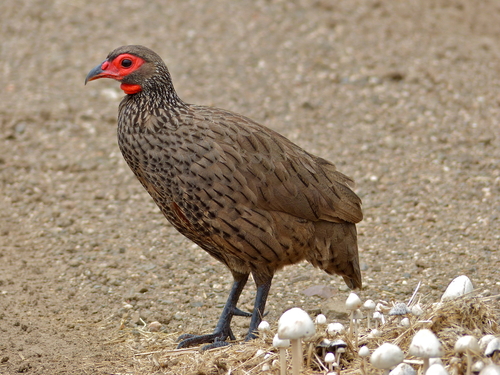
Swainson's Spurfowl
Pternistis swainsonii
With its vibrant red throat and raucous morning call, the Swainson's Spurfowl is a charismatic icon of the Southern African bush. This hardy ground-dweller has mastered the art of living alongside humans, making it a frequent and entertaining visitor to backyard cameras.
Quick Identification
Size
Length of 33–38 cm (13–15 in); weight ranges from 400–900 g (0.8–2.0 lbs), with males being significantly larger than females.
Colors
Streaky brownish-grey plumage with dark belly markings; distinctive bare, bright red throat and facial skin; blackish bill and dark brown legs.
Key Features
- Bare red skin around the eyes and on the throat
- Dark brownish-grey plumage with heavy black streaking on the underparts
- Noisy, harsh 'kraa-kraa-kraa' call, especially at dawn
- Robust, chicken-like build with a short tail
When You’ll See Them
Sightings on EverydayEarth
Jul 24, 2026
A pair of Swainson's Spurfowls are foraging on the ground near the edge of the watering hole. Mid-way through the sequence, a large flock of small birds flies rapidly into the frame from the right, banking over the water and landing near the banks to drink.
Jul 23, 2026
Two birds are foraging near a waterhole under the cover of night. One stands on the far left bank, while the other walks along the edge of the water before coming to a stop.
Jul 19, 2026
Two Swainson's Spurfowls are visible on the right side of the waterhole. One stands near the water's edge, while the other is positioned further back in the dry, sun-baked grass. They appear to be resting and occasionally foraging in the morning light.
Jul 19, 2026
Two Swainson's Spurfowls are foraging at the edge of a watering hole. One bird is clearly visible on the left bank, walking purposefully while displaying its distinctive red facial skin, while a second individual is seen further back near the water's edge.
Jul 17, 2026
Two Swainson's Spurfowls are foraging at the edge of a woodland water hole. One bird is positioned centrally in the frame, periodically moving its head to scan for predators, while a second individual is visible further to the right near the water's edge.
Jul 17, 2026
A Swainson's Spurfowl is seen foraging on the dry ground to the left of the watering hole. Meanwhile, a Grey Heron stands motionless on the bank in the center of the frame, reflected in the still water. In the background, other small birds, likely lapwings, are visible near the water's edge.
Geographic range
Where Does the Swainson's Spurfowl Live?
Native to the southern regions of the African continent, the Swainson's Spurfowl thrives across a wide belt of Southern Africa. Its core populations are found throughout South Africa, Zimbabwe, Botswana, and Namibia, extending into parts of Mozambique and Zambia. Because it thrives in agricultural landscapes, it has successfully expanded its range into areas that were previously dominated by dense woodland or dry scrub.
Basemap © OpenStreetMap contributors
Behavior
Swainson's Spurfowl is a primarily terrestrial bird that spends the vast majority of its day foraging on the ground. They are famously vocal, known for their loud, raucous morning calls that often serve as a natural alarm clock across the African savanna. While they are capable flyers, they generally prefer to escape danger by running into thick cover, only taking flight as a last resort when cornered.
These birds are social creatures, typically found in pairs or small family coveys. They have adapted remarkably well to human presence and are frequent visitors to suburban gardens or farmsteads where they scavenge for fallen grain. Despite their relative boldness around humans, they remain highly alert to predators and will quickly retreat into the undergrowth if they sense a threat.
EverydayEarth exclusive
Camera Tips
To capture high-quality footage of Swainson's Spurfowl, place your AI-powered camera low to the ground—ideally no more than 15 to 30 centimeters (6-12 inches) high. These are strictly ground-dwelling birds, and a low angle provides a much more intimate, eye-level perspective of their intricate feather patterns and vibrant red facial skin. Aim the camera toward a clearing near dense bushes, as they like to stay close to 'escape cover' where they feel safe.
Baiting is highly effective for this species. A small scattering of wild bird seed, cracked corn, or even mealworms in front of the lens will keep them occupied long enough for your camera to trigger several times. If you are in a suburban setting, setting up near a leaking garden tap or a low-profile bird bath is also a great strategy, as they frequently visit water sources in the early morning and late afternoon heat.
Timing is crucial for capturing the best behavior. Ensure your camera is active during the 'golden hours'—the first two hours after sunrise and the last two hours before sunset. This is when they are most active, vocal, and social. During the peak heat of the day, they tend to stay deep in the shade of thickets where your camera might struggle with low-light triggers or heavy shadows.
For settings, use a fast shutter speed or a high-frame-rate video mode if your camera supports it. Spurfowl are jerky movers, often bobbing their heads and scratching at the ground rapidly. A standard trail camera might produce blurred images if the shutter is too slow. If your camera has a 'burst' mode, set it to take 3-5 photos per trigger to catch the perfect pose amidst their constant movement.
Similar Species
Species that look similar or are commonly confused with Swainson's Spurfowl.
Natal Spurfowl
Differentiated by its orange-red legs and more mottled, less streaky appearance on the underparts compared to Swainson's.
Cape Spurfowl
Features white-speckled plumage and lacks the extensive bare red throat seen in Swainson's.
Red-billed Spurfowl
Has a conspicuous red bill and yellow skin around the eyes, whereas Swainson's has a dark bill and red facial skin.
Frequently Asked Questions
Record Swainson's Spurfowl at your habitat
Connect a camera to start building your own species record — AI identifies every visitor automatically.