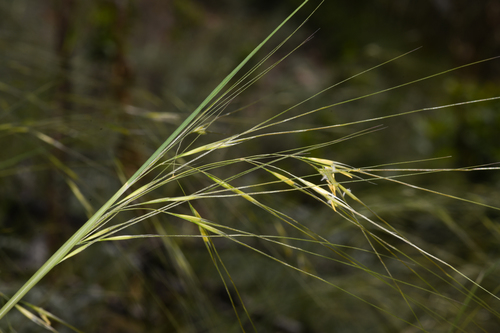
Needle-and-thread Grass
Hesperostipa comata
The mechanical marvel of the prairie, this grass uses shimmering 'threads' to literally drill its seeds into the earth. Its graceful movement and golden summer glow make it a favorite for backyard naturalists and photographers alike.
Quick Identification
Size
Stands 12 to 48 inches (30 to 120 cm) tall with seed awns reaching 4 to 8 inches (10 to 20 cm) in length.
Colors
Light silvery-green foliage turning to a golden straw-colored hue as the seeds mature; seeds are dark brown with pale, shimmering thread-like tails.
Key Features
- Extremely long, twisted awns that resemble a needle and thread
- Dense clumping bunchgrass growth habit
- Narrow, inward-rolling leaf blades
- Panicle seed heads that remain partly enclosed in the upper leaf sheath
When You’ll See Them
Behavior
Needle-and-thread Grass is a perennial bunchgrass famous for its unique seed dispersal mechanism. As the seeds mature in early summer, the long, hair-like awns (the 'thread') respond to changes in humidity. When moisture hits the awn, it twists and uncoils, effectively acting like a drill that pushes the sharp seed (the 'needle') into the soil. This fascinating mechanical movement ensures the next generation is planted at the optimal depth for germination.
While it is a hardy survivor in dry western climates, it also plays a vital role in the ecosystem. In early spring, it provides high-quality forage for deer and elk before it develops its sharp seeds. Once the seeds harden, they can actually be hazardous to livestock and pets, as the 'needles' are designed to burrow into surfaces, including fur and skin. In your backyard, it serves as a beautiful, rhythmic element that sways gracefully with the slightest breeze.
EverydayEarth exclusive
Camera Tips
To capture the ethereal beauty of Needle-and-thread Grass, positioning is everything. Use a low-angle camera mount or stake your camera about 12-18 inches off the ground. This perspective allows you to capture the long, sweeping awns against the sky, highlighting their translucent quality. Because this grass moves constantly, use a fast shutter speed if you want to freeze the 'threads' in motion, or a slower shutter speed (0.5 to 1 second) during the day with an ND filter to create a soft, painterly blur of the swaying seeds.
The 'needle and thread' effect is most dramatic when backlit. Position your camera facing toward the sunrise or sunset so the light catches the fine hairs of the awns, making them glow like fiber optics. If your camera has a macro setting or a high-quality lens, try to frame a close-up of the seed head; the intricate spiral of the awn is a marvel of natural engineering that looks incredible in high-definition stills.
For a truly unique project, set your camera to 'Timelapse' mode during a rainstorm or a period of high humidity. By focusing on a fallen seed on bare soil, you can actually record the mechanical 'drilling' action as the awn twists and drives the seed into the earth. This is a rare sight that most people never see, and it makes for a captivating piece of backyard wildlife footage. Ensure the camera is well-secured and protected from the elements for this type of shot.
Similar Species
Species that look similar or are commonly confused with Needle-and-thread Grass.
Frequently Asked Questions
Record Needle-and-thread Grass at your habitat
Connect a camera to start building your own species record — AI identifies every visitor automatically.