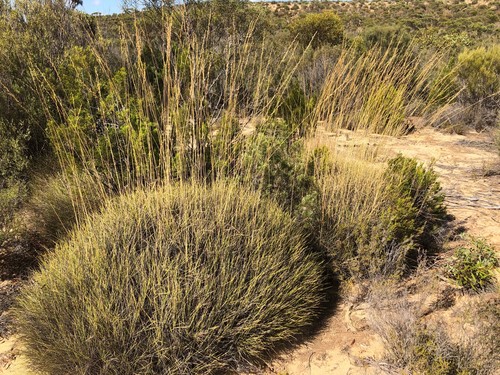
Porcupine Grass
Triodia scariosa
The ultimate desert fortress, Porcupine Grass forms dense, prickly hummocks that provide a vital sanctuary for Australia's most elusive reptiles and birds.
Quick Identification
Size
Hummocks grow up to 1m (3.3 ft) tall; flowering stalks can reach up to 2m (6.6 ft).
Colors
Foliage ranges from dusty olive to bright green; flower heads are pale straw to light brown.
Key Features
- Dense, mound-shaped hummock growth habit
- Rigid, needle-sharp leaves roughly 30cm long
- Tall, narrow flower stalks (panicles) that rise well above the foliage
- Evergreen leaves that maintain color even in extreme drought
When You’ll See Them
Behavior
Porcupine Grass is a cornerstone of the Australian arid landscape, growing in iconic, prickly mounds known as hummocks. As these plants age, they often exhibit a fascinating growth pattern where the center of the mound dies off, leaving a widening ring of living grass. This growth habit isn't just a quirk of biology; it creates essential micro-habitats and 'thermal refuges' for a vast array of desert-dwelling wildlife.
Ecologically, this species is a master of defense and survival. Its sharp, needle-like leaves are high in silica, making them unpalatable to many herbivores and providing a literal fortress for small creatures. In a backyard or trail setting, Porcupine Grass acts as a high-security nursery where lizards, small marsupials, and specialized birds can hide from predators like hawks or feral cats.
EverydayEarth exclusive
Camera Tips
When setting up an AI camera to monitor Porcupine Grass, remember that the plant itself is a static subject, but its structure is a magnet for movement. Place your camera on a low mount or ground stake, roughly 10 to 20 centimeters (4-8 inches) off the ground. Angle the lens slightly upward toward the base of the hummock. This 'reptile-eye-view' is essential for capturing the skinks, geckos, and dragons that use the prickly interior of the grass as a home base.
To capture the most striking images of the grass itself, focus on the 'Golden Hour'—the hour after sunrise or before sunset. The low-angle sunlight hits the rigid, needle-like leaves, creating sharp highlights and deep shadows that emphasize the plant's unique texture. If your camera allows for manual focus or zone focusing, set it to the front edge of the mound where wildlife is most likely to emerge into the clearing.
Don't ignore the flowering stalks. During the blooming season, these 2-meter-tall spikes are favorite perches for honeyeaters and other small birds. Position a second camera further back with a wider field of view to capture these vertical elements. Because the grass is often found in windy, open areas, ensure your camera is securely anchored; even small vibrations can cause 'false triggers' if the sharp leaves blow across the PIR sensor's field of view.
Finally, consider the 'runway' effect. Wildlife rarely crashes through the middle of a Porcupine Grass mound; they follow the clear paths between the hummocks. If you have multiple mounds, point your camera at the sandy gaps between them. Increasing your camera's trigger speed or setting it to 'Burst Mode' is highly recommended, as the small animals moving between these protective fortresses often move with incredible speed to avoid detection.
Similar Species
Species that look similar or are commonly confused with Porcupine Grass.
Frequently Asked Questions
Record Porcupine Grass at your habitat
Connect a camera to start building your own species record — AI identifies every visitor automatically.