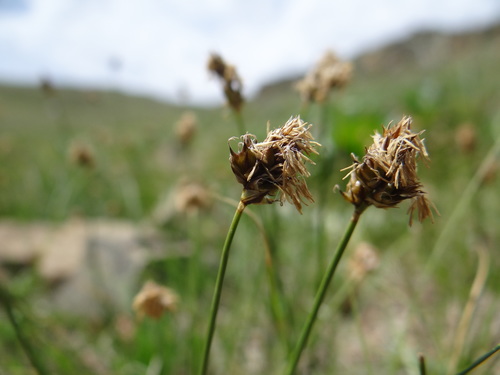
Needleleaf sedge
Carex duriuscula
The ultimate survivor of the plains, Needleleaf sedge is a tiny powerhouse that turns dry, sandy soil into a resilient green carpet. Perfect for low-water backyards, this sedge is as tough as it is delicate in appearance.
Quick Identification
Size
A low-growing species typically reaching 5 to 20 cm (2 to 8 inches) in height with very narrow, thread-like leaves.
Colors
Bright to dull green foliage, turning straw-colored in dormancy; flowering spikes are dark brown to blackish.
Key Features
- Fine, needle-like leaves less than 1mm wide
- Clump-forming with creeping rhizomes
- Small, clustered brown flower spikes at the stem tips
- Extremely drought-tolerant, sod-forming growth habit
When You’ll See Them
Geographic range
Where Does the Needleleaf sedge Live?
Needleleaf sedge is native to a vast stretch of the Northern Hemisphere, spanning across North America and Eurasia. In North America, its core range extends from Alaska and the Yukon down through the Great Plains and the Rocky Mountain states, reaching as far south as New Mexico and Arizona. Across the ocean, it is widely distributed through Russia, Mongolia, and Northern China, where it is a staple of the cold steppe environments.
Basemap © OpenStreetMap contributors
Behavior
Needleleaf sedge is a remarkably resilient perennial that functions as a tough, low-profile ground cover in some of the world's most challenging environments. Unlike many lush garden plants, this sedge thrives on neglect, utilizing a deep and wiry rhizome system to stabilize soil and survive long periods of drought. It is one of the first plants to green up in the early spring, providing an essential early food source for grazing wildlife and insects.
In a backyard setting, this species behaves as a "living mulch," slowly spreading to fill gaps between larger plants. It does not compete aggressively with tall perennials but instead forms a thick, carpet-like mat that prevents soil erosion. While it doesn't 'behave' in the animal sense, it shows a distinct reaction to the seasons, curing to a golden-tan color in the heat of summer or the depths of winter, only to bounce back with the first sign of moisture.
EverydayEarth exclusive
Camera Tips
To capture the subtle beauty of Needleleaf sedge, you need to think small and low. Since this plant rarely exceeds 8 inches in height, mount your camera on a ground-level stake or a low-profile brick. Angle the lens slightly upward to catch the silhouette of the dark seed heads against the sky or a lighter background. This perspective also allows you to see the "needle" texture of the leaves that gives the plant its name.
Because sedges don't move much on their own, they make excellent subjects for time-lapse photography. Set your camera to take a photo every 30 minutes during the spring growing season to document the rapid emergence of the flower spikes. On windy days, use a faster shutter speed if your camera allows, or embrace the motion blur to show the 'wavy' nature of a sedge-filled lawn. The fine texture of the leaves catches morning dew beautifully, so ensure your camera is positioned to catch the early morning light from the side.
These plants are often visited by small mammals like ground squirrels or pollinators like native bees. To capture these interactions, place a small amount of water nearby (but not on the plant) to encourage wildlife to linger in the frame. If you are using a trail camera with infrared (IR) for night shots, the thin leaves may appear overexposed; try placing the camera at least 3-4 feet away and zooming in if possible to avoid the 'white-out' effect on the foliage.
Similar Species
Species that look similar or are commonly confused with Needleleaf sedge.
Threadleaf Sedge
Threadleaf (Carex filifolia) has a distinctive chestnut-brown, papery base at the bottom of its stems and slightly thicker leaves.
Blue Grama
While it shares the same habitat, Blue Grama is a true grass with 'eyebrow-shaped' seed heads rather than the dark, spiked clusters of the sedge.
Frequently Asked Questions
Record Needleleaf sedge at your habitat
Connect a camera to start building your own species record — AI identifies every visitor automatically.