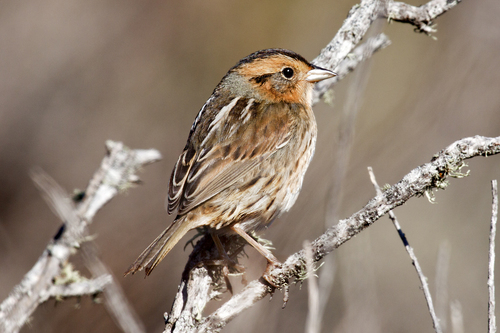
Nelson's Sparrow
Ammospiza nelsoni
The Nelson's Sparrow is a master of disguise, painted in rich autumnal oranges and soft grays to blend perfectly with its marshland home. Often heard but rarely seen, this elusive 'marsh mouse' offers a rewarding challenge for any wildlife photographer.
Quick Identification
Size
Length: 11-13 cm (4.3-5.1 in); Wingspan: 17-20 cm (6.7-7.9 in); Weight: 17-21 g (0.6-0.7 oz)
Colors
Bright ochre or orange-buff face and breast; slate-gray ear patch and nape; dark brown wings with white streaks; white belly. Males and females look identical.
Key Features
- Rich orange-buff 'spectacle' pattern on the face
- Distinct gray ear patch contrasting with orange surroundings
- Short, pointed tail and relatively large, sharp bill
- Fine, blurry streaking on the sides and breast
When You’ll See Them
Behavior
Nelson's Sparrow is one of the most secretive birds you’ll encounter. Unlike many songbirds that flit through branches, this species spends the majority of its time on the ground, literally running through thick marsh grass like a mouse. They are so reluctant to fly that they will often wait until you are nearly stepping on them before flushing, only to drop back into the safety of the vegetation a few yards away.
During the breeding season, males have a peculiar, quiet song that sounds like a drop of water hitting a hot frying pan—a sharp hiss followed by a faint trail. They aren't particularly social with humans and rarely visit traditional hanging feeders, preferring the safety of dense cover. However, they are fascinating to watch if you can catch them foraging along the muddy edges of a marsh during a falling tide.
EverydayEarth exclusive
Camera Tips
Capturing a Nelson's Sparrow on camera requires a different strategy than your average backyard bird. Because they are ground-dwellers, you must place your camera very low—ideally no more than 6 to 12 inches off the ground. Aim the lens at 'natural corridors' like the edge of a reed bed or a muddy path where the grass meets standing water. This is where they are most likely to emerge from cover to forage.
Standard birdseed rarely works for this species. Instead, the best 'lure' is a very shallow, natural-looking water feature. A solar-powered dripper or a small recirculating pump that creates a gentle splashing sound can be irresistible to a thirsty sparrow hiding in the reeds. Position your camera to focus on a flat rock or a bit of mud right at the water's edge.
If you are in a coastal area, timing your camera checks with the tides is essential. High tide pushes these birds out of the lower marsh and into the higher, drier grass where your camera is more likely to be situated. During spring tides, they may even be forced into the open, providing the best photographic opportunities of the year.
Set your camera to 'Burst Mode' or high-speed video. Nelson's Sparrows move with quick, jerky motions and rarely stay still for long. A fast trigger speed (under 0.5 seconds) is vital, or you may find yourself with nothing but a photo of a disappearing tail feather. If your camera allows for sensitivity adjustments, set the PIR sensor to high, as these birds are small and light, sometimes failing to trigger less sensitive sensors.
Similar Species
Species that look similar or are commonly confused with Nelson's Sparrow.
Saltmarsh Sparrow
Very similar orange face, but has much cleaner, sharper dark streaks on the breast and a larger bill.
LeConte's Sparrow
Smaller with a much more prominent white stripe down the center of the crown and lacks the gray ear patch.
Savannah Sparrow
Lacks the bright orange-buff face and instead has a small, distinct yellow patch in front of the eye.
Frequently Asked Questions
Record Nelson's Sparrow at your habitat
Connect a camera to start building your own species record — AI identifies every visitor automatically.