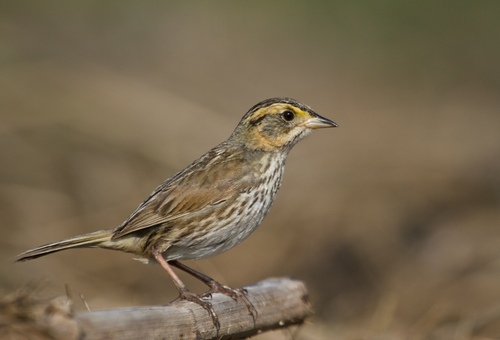
Saltmarsh Sparrow
Ammospiza caudacuta
The ghost of the Atlantic coast, the Saltmarsh Sparrow is a master of camouflage that lives its entire life between the tides. With its vibrant orange face and secretive nature, spotting one is a true reward for any backyard birder.
Quick Identification
Size
Length: 4.7-5.1 in (12-13 cm) | Wingspan: 16-18 cm (6.3-7.1 in) | Weight: 0.5-0.8 oz (14-23 g)
Colors
Rich ochre-orange face with a distinct gray ear patch; buffy breast with dark, sharp streaks; gray-brown back with white feather edges. Sexes look identical.
Key Features
- Bright orange-buff triangular markings on the face
- Short, pointed tail feathers often held low
- Heavily streaked buffy breast and flanks
- Large bill compared to other small sparrows
When You’ll See Them
Behavior
The Saltmarsh Sparrow is one of the most secretive birds in North America, often referred to as 'mouse-like' because of its habit of scurrying through dense marsh grass rather than flying. Unlike many other songbirds, they are not strictly territorial; males roam widely across the marsh to find mates, and they do not form long-term pair bonds. You'll rarely see them perched high on a branch; instead, they stay low in the cordgrass, emerging only briefly to flutter to a new patch of cover.
Their life is entirely dictated by the moon and the tides. They nest in the 'high marsh' zone, timing their entire reproductive cycle—from egg-laying to fledging—to fit within the 28-day window between the highest spring tides. Because of this high-stakes lifestyle, they are extremely sensitive to habitat changes and rising sea levels, making them a high-priority species for coastal conservationists.
EverydayEarth exclusive
Camera Tips
Capturing a Saltmarsh Sparrow on camera requires a strategic approach because they rarely visit traditional bird feeders. To find them, position your camera at the edge of the 'high marsh'—the area that only floods during the highest monthly tides. Look for transitions where dense Saltmeadow Cordgrass meets open mudflats or small tidal pools. This is where they forage for insects and are most likely to step into an open area for a clear shot.
Since these birds stay low to the ground, your camera should be mounted very low, ideally only 6 to 12 inches above the marsh surface. Because the environment is tidal, use a waterproof housing and ensure your mount is extremely secure; a heavy-duty stake or a weighted platform is better than a tripod, which might sink into the peat. Angle the camera slightly upward to capture the beautiful orange detailing on their faces against the green and gold of the marsh grass.
Timing is everything. Check your local tide charts and set your camera to be most active during the two hours before and after low tide. As the water recedes, the sparrows emerge from the thick grass to hunt on the exposed mud. Early morning light is particularly flattering for this species, as the low sun brings out the rich ochre tones in their plumage that can look dull on overcast days.
If you are trying to attract them to a specific spot, a small, shallow solar-powered water dripper placed on a flat piece of driftwood can work wonders. While they live in a salty environment, many marsh birds are drawn to fresh, moving water for bathing. Ensure the camera is set to a high-speed trigger or 'burst mode,' as their movements are quick and erratic as they dart between stalks of grass.
Similar Species
Species that look similar or are commonly confused with Saltmarsh Sparrow.
Nelson's Sparrow
Very similar orange face, but has blurrier, less distinct streaks on the breast and a slightly smaller bill.
Seaside Sparrow
Larger and darker gray overall, with a yellow patch in front of the eye but lacking the orange triangular face pattern.
Savannah Sparrow
Features a smaller, yellow spot near the eye and lacks the rich ochre/orange face of the Saltmarsh Sparrow.
Frequently Asked Questions
Record Saltmarsh Sparrow at your habitat
Connect a camera to start building your own species record — AI identifies every visitor automatically.