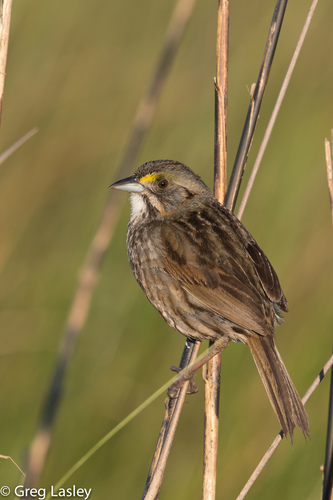
Seaside Sparrow
Ammospiza maritima
A hardy specialist of the coastal fringe, the Seaside Sparrow is a master of the salt marsh. With its robust bill and distinctive yellow highlights, this elusive bird offers a rare and rewarding glimpse into the rhythm of the tides.
Quick Identification
Size
Length: 5.1-5.9 in (13-15 cm); Wingspan: 7.1-8.3 in (18-21 cm); Weight: 0.7-1.0 oz (19-28 g)
Colors
Primarily drab olive-gray or brownish-gray; notable yellow patch (lores) in front of the eyes; grayish-white throat and a pale 'mustache' stripe.
Key Features
- Large, heavy bill compared to most sparrows
- Yellow lores (spot between eye and bill)
- Drab, grayish plumage with subtle breast streaking
- Short, pointed tail and large feet for marsh walking
When You’ll See Them
Behavior
The Seaside Sparrow is a specialist of the salt marsh, often behaving more like a mouse than a bird. They are notoriously secretive, preferring to scuttle through dense cordgrass and rushes rather than fly. When they do take flight, it is usually a short, low-pitched burst before dropping back into the vegetation. Despite their shy nature, they can be quite bold during the breeding season when males perch atop the tallest blades of grass to deliver their buzzy, mechanical-sounding song.
These sparrows are highly adapted to the tidal environment. They are one of the few bird species that can thrive in habitats that are regularly flooded by tides. They have evolved specialized salt glands to excrete excess salt, allowing them to drink brackish water. Their social structure is somewhat loose, but they often nest in small, informal colonies where suitable habitat is abundant.
Interactions with humans are rare because of their specific habitat requirements. They are rarely seen in traditional suburban backyards unless those yards directly border a salt marsh or tidal creek. They are an excellent indicator species for the health of coastal ecosystems, as they are sensitive to sea-level rise and habitat fragmentation.
EverydayEarth exclusive
Camera Tips
Capturing the Seaside Sparrow on a trail camera requires a deep understanding of the tides. Because these birds live almost exclusively in the 'intertidal zone,' you must place your camera in areas that are high enough to avoid being submerged during high tide, but close enough to the mudflats where they forage. Look for 'high marsh' areas characterized by Saltmeadow Cordgrass (Spartina patens). Mount your camera on a sturdy stake or a PVC pipe driven into the mud, keeping the lens about 12 to 18 inches above the ground to capture their ground-level foraging behavior.
Standard bird feeders are rarely successful for this species. Instead, look for 'song perches.' During the spring, males will repeatedly use the same tall reed or shrub (like Groundsel Bush or Marsh Elder) to sing. If you can identify a preferred perch, aim your camera at the top of that vegetation. Since these birds are drab and blend into the gray-brown marsh grass, use a camera with a high-resolution sensor and fast trigger speed to distinguish them from the moving wind-blown reeds.
Freshwater is a massive draw for Seaside Sparrows. While they can handle salt, they highly prefer bathing and drinking in fresh or slightly brackish water. If your property borders a marsh, placing a shallow, ground-level birdbath near the marsh edge is the single best way to lure them into camera range. Ensure the water is kept clean and very shallow, as they are small birds that prefer to wade rather than dive.
For camera settings, prioritize a fast shutter speed to combat the constant movement of the marsh grass and the bird's quick, jerky movements. If your camera allows for 'Hybrid Mode' (taking a photo followed by a short video clip), use it. The video is often necessary to distinguish the Seaside Sparrow from other similar species by its unique 'scuttling' walk and its distinctive, buzzy song which can be picked up by the microphone.
Similar Species
Species that look similar or are commonly confused with Seaside Sparrow.
Saltmarsh Sparrow
Smaller with bright orange-buff facial markings and much thinner breast streaks.
Nelson's Sparrow
Smaller with a shorter bill and a brighter, unstreaked orange-buff breast.
Savannah Sparrow
Smaller bill, lighter brown color, and more distinct white-and-brown streaking throughout the body.
Frequently Asked Questions
Record Seaside Sparrow at your habitat
Connect a camera to start building your own species record — AI identifies every visitor automatically.