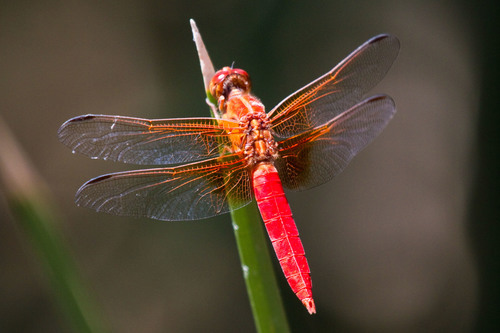
Neon Skimmer
Libellula croceipennis
With its electrifying red body that looks almost battery-powered, the Neon Skimmer is the crown jewel of southwestern wetlands. This bold, territorial dragonfly is a master of the air, turning any backyard pond into a stage for its high-speed aerial acrobatics.
Quick Identification
Size
Length: 53–59 mm (2.1–2.3 in); Wingspan: 80–95 mm (3.1–3.7 in)
Colors
Mature males are a brilliant, luminous fire-engine red or neon orange. Females and juveniles are golden-brown with a thin yellow line along the back.
Key Features
- Intense neon-red coloration on mature males
- Stout, thick abdomen compared to other skimmers
- Bright red eyes and red-tinted veins near the wing bases
- Aggressive perching behavior on prominent twigs or reeds
When You’ll See Them
Behavior
The Neon Skimmer is a classic "percher," spending much of its day stationed on a prominent twig, reed, or rock near the water's edge. From these vantage points, males keep a watchful eye for both prey and encroaching rivals. They are famously territorial; if another male enters their airspace, a high-speed aerial dogfight usually ensues until the intruder is chased away. Unlike some dragonflies that spend hours on the wing, Neon Skimmers prefer short, explosive bursts of flight followed by a return to their favorite lookout.
While they are formidable predators of the insect world, they are completely harmless to humans. They do not sting and rarely bite unless handled roughly. In fact, they are beneficial neighbors to have in a backyard, as they act as natural pest controllers, patrolling the air for mosquitoes, gnats, and small flies. Their presence is often a sign of a healthy aquatic ecosystem nearby, as their larvae require clean, slow-moving water to develop.
EverydayEarth exclusive
Camera Tips
Capturing the vibrant glow of a Neon Skimmer requires focusing on their "home base." These dragonflies are creatures of habit and will return to the exact same perch dozens of times a day. Look for a vertical reed or a sun-drenched twig sticking out of the water or near the shoreline. Position your AI-powered camera about 2 to 4 feet away from these potential perches, ensuring the background is distant enough to create a soft blur that makes the red body really pop against the scenery.
Because Neon Skimmers are most active during the hottest, brightest parts of the day, lighting is your best friend and your biggest challenge. Set your camera to point slightly away from the direct sun to avoid "blown out" highlights on their shiny wings, but ensure the dragonfly's body is well-lit to capture that signature fluorescent effect. If your camera allows for manual shutter speed settings, aim for 1/1000s or faster; even when perched, their heads move rapidly, and they can take off in a split second. Using a "burst" mode or high-speed video trigger is essential for catching the moment they launch into flight.
You don't need traditional bait for dragonflies, but you can "engineer" a photo opportunity. By placing an attractive, solitary bamboo stake or a decorative branch in a sunny spot near a pond or birdbath, you provide an irresistible lookout post. Within a day or two, a male Neon Skimmer will likely claim it as his throne. For the best results, set your camera's trigger sensitivity to its highest setting, as their small body mass might not always trigger standard motion sensors unless they are very close to the lens or filling a significant portion of the frame.
Similar Species
Species that look similar or are commonly confused with Neon Skimmer.
Frequently Asked Questions
Record Neon Skimmer at your habitat
Connect a camera to start building your own species record — AI identifies every visitor automatically.