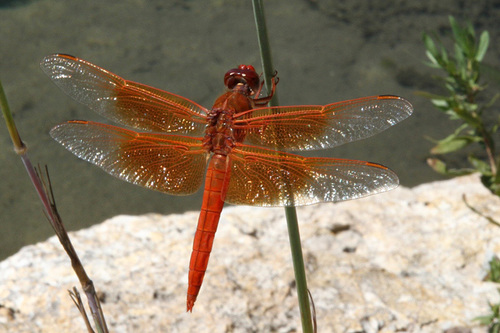
Flame Skimmer
Libellula saturata
The Flame Skimmer is a living ember in the summer garden, sporting a brilliant orange hue that seems to glow in the midday sun. A master of the air, this common backyard visitor is as beneficial as it is beautiful, acting as a natural predator for garden pests.
Quick Identification
Size
Length: 50–60 mm (2.0–2.4 in); Wingspan: 80–90 mm (3.1–3.5 in)
Colors
Males are a brilliant, uniform fiery orange-red from head to tail, including the wing veins. Females and juveniles are a more subtle golden-brown or amber color with two pale stripes on the thorax.
Key Features
- Vivid orange wash extending across the inner half of all four wings
- Thick, robust abdomen without dark markings on the tip
- Large compound eyes that meet at the top of the head
- Perching posture with wings slightly tilted forward
When You’ll See Them
Behavior
Flame Skimmers are bold, territorial dragonflies known for their conspicuous 'perching' behavior. Unlike some dragonflies that spend most of their time patrolling on the wing, Flame Skimmers prefer to sit on a prominent twig, reed, or garden stake, darting out to snatch passing prey before returning to the exact same spot. This 'sit-and-wait' hunting strategy makes them exceptionally rewarding for backyard observers.
During the heat of the day, you might see them perform a behavior called 'obelisking,' where they raise their abdomen toward the sun to minimize surface area exposure and stay cool. They are generally indifferent to humans, often allowing a close approach if you move slowly, making them one of the more approachable insects for home photography. Males are fiercely protective of their pond territory, frequently chasing away rival males in high-speed aerial dogfights.
EverydayEarth exclusive
Camera Tips
To capture high-quality images of a Flame Skimmer, you need to exploit their habit of returning to the same perch. Identify a vertical twig or garden stake near a water source where you have seen one land previously. Mount your camera on a tripod or stable surface approximately 2 to 4 feet away from the tip of this perch. Since dragonflies are cold-blooded, they are most active when the sun is hitting their perch directly, so position your camera with the sun at your back to illuminate the brilliant orange of the male’s wings.
Because these insects move incredibly fast during takeoff, use a high shutter speed setting if your camera allows (at least 1/1000th of a second) to freeze the wing motion. If you are using an AI-powered backyard camera, look for a 'macro' or 'close-up' focus mode. If the camera has a motion trigger, set the sensitivity to high, as the dragonfly’s small body may not always trigger sensors designed for larger mammals.
You can 'land-mine' your garden by placing several attractive bamboo stakes or tall thin branches in open, sunny areas near water. This creates a predictable stage for the dragonfly to land on. Ensure the background is several feet behind the perch to create a soft, blurred effect (bokeh) that makes the fiery orange insect pop. Early morning is the best time for setup; while they aren't active yet, they are less likely to be spooked by your presence as you calibrate the lens focus.
Similar Species
Species that look similar or are commonly confused with Flame Skimmer.
Neon Skimmer
The Neon Skimmer is a deeper, more solid red, and the orange tint in its wings is usually confined closer to the body compared to the Flame Skimmer.
Cardinal Meadowhawk
Much smaller in size with clear wings (no orange wash) and black markings on the sides of the abdomen.
Roseate Skimmer
Males have a distinct rose-pink or purplish thorax and abdomen, rather than the bright orange of the Flame Skimmer.
Frequently Asked Questions
Record Flame Skimmer at your habitat
Connect a camera to start building your own species record — AI identifies every visitor automatically.