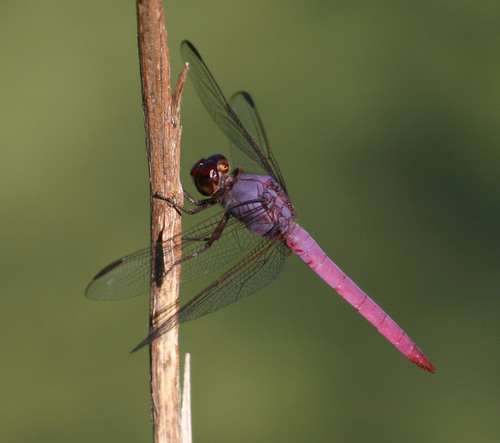
Roseate Skimmer
Orthemis ferruginea
A bold splash of neon pink in the garden, the Roseate Skimmer is one of the most stunning dragonflies you'll encounter. Known for its vibrant magenta body and territorial aerial displays, this common visitor is a master of backyard pond patrol.
Quick Identification
Size
Total length: 45–55 mm (1.8–2.2 in); Wingspan: 80–90 mm (3.1–3.5 in)
Colors
Adult males are a vibrant rose-pink to magenta on the abdomen with a brownish-purple thorax. Females and juveniles are olive-brown with a distinct white or pale stripe along the top of the thorax.
Key Features
- Vibrant magenta or rose-pink abdomen in mature males
- Thick, robust body compared to narrower dragonflies
- Clear wings with small dark spots at the base
- Wide brownish thorax with a purple hue in males
When You’ll See Them
Behavior
The Roseate Skimmer is a classic "percher" dragonfly. Unlike some species that spend most of their time patrolling on the wing, this dragonfly prefers to sit on a prominent twig, reed, or even a backyard fence, darting out to snatch prey before returning to the same spot. They are highly territorial, and you will often see males engaging in mid-air dogfights to defend their preferred hunting grounds near water.
During the hottest parts of the day, you might observe them performing the 'obelisk posture,' where they raise their abdomen straight up toward the sun. This behavior helps them regulate their body temperature by minimizing the surface area exposed to direct sunlight. While they are wary of sudden movements, they are generally tolerant of humans and can be observed quite closely if approached slowly.
EverydayEarth exclusive
Camera Tips
To capture high-quality images of a Roseate Skimmer, focus on their habitual behavior. Because they are perchers, they often return to the exact same twig or leaf after a hunting flight. Identify a prominent, sunlit branch near a water source and position your camera about 2 to 3 feet away. If your AI camera has a macro or close-focus setting, ensure it is engaged to capture the intricate wing veining and the stunning magenta hue of the male’s abdomen.
Angle is everything with these insects. To get the best profile shot, set your camera at the same height as the perch rather than looking down from above. This perspective captures the 'face' of the dragonfly and the full length of the body. If your camera allows for manual trigger zones, focus the zone precisely on the tip of the perch. Use a fast shutter speed or a high-frame-rate video setting, as their takeoff and landing happen in the blink of an eye.
Lighting can make or break a shot of a Roseate Skimmer. Mid-morning light is usually best, as it highlights the iridescent purple tones of the thorax without the harsh shadows of high noon. If you are using a trail camera, try to position it so the sun is behind the camera or to the side; backlighting can be beautiful but often washes out the specific rose-pink color that makes this species so unique. Avoid placing the camera where vegetation will blow in the wind, as this will result in thousands of empty triggers.
For the most consistent results, consider adding a 'natural' camera trap. Place a slender, vertical bamboo stake or a dried branch near the edge of a pond or birdbath. Roseate Skimmers find these artificial perches irresistible. Once a male claims the stake as his territory, you can be certain he will return to that spot throughout the day, providing you with endless opportunities for the perfect capture.
Similar Species
Species that look similar or are commonly confused with Roseate Skimmer.
Flame Skimmer
The Flame Skimmer is bright orange-red rather than magenta, and has significant orange coloring in the wing bases.
Neon Skimmer
Neon Skimmers are a more solid, intense red and lack the brownish-purple thorax seen on Roseate Skimmers.
Blue Dasher
Blue Dashers are smaller with a distinct blue pruinose abdomen and green eyes, whereas Roseates are larger and pink.
Frequently Asked Questions
Record Roseate Skimmer at your habitat
Connect a camera to start building your own species record — AI identifies every visitor automatically.