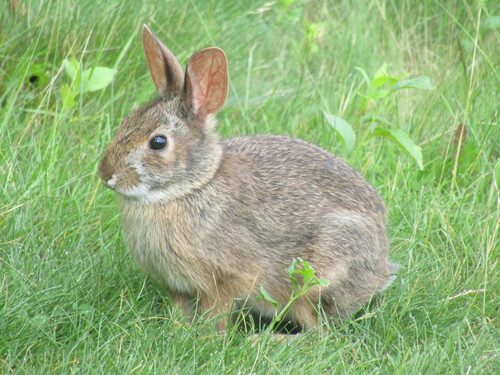
New England Cottontail
Sylvilagus transitionalis
The New England Cottontail is the Northeast's original brush-dweller, a master of the thicket that thrives in the densest tangles. Rare and elusive, this native rabbit is a prize for any backyard wildlife enthusiast to capture on camera.
Quick Identification
Size
Length: 15.5-17 inches (39-43 cm); Weight: 2.2-2.9 lbs (1.0-1.3 kg)
Colors
Brownish-gray coat with distinctive black-tipped hairs (agouti), a white belly, and a signature cottony-white tail. Males and females look nearly identical.
Key Features
- Distinctive black spot between the ears
- Shorter ears than the Eastern Cottontail
- Fine black line along the outer edge of the ear
- Stocky, compact body designed for dense brush
When You’ll See Them
Behavior
The New England Cottontail is a shy, secretive mammal known for its extreme reliance on "young forest" habitats or thickets. Unlike many other rabbit species that venture into open fields, this cottontail is a habitat specialist that rarely moves more than a few feet away from dense, tangled cover. They are highly alert and spend much of their time scanning for predators like hawks, foxes, and bobcats while remaining perfectly still under a canopy of shrubs.
While they are generally solitary animals, they may congregate in areas with high-quality food sources, though they do not form social colonies. They interact with humans only by avoidance; they are much more difficult to spot in suburban backyards than the more common Eastern Cottontail. When startled, they use a zig-zag running pattern to flee back into the thickest briars available, where their predators struggle to follow.
EverydayEarth exclusive
Camera Tips
To capture the elusive New England Cottontail, camera placement is everything. Unlike their more adventurous cousins, these rabbits rarely venture into the center of a manicured lawn. Position your camera at "bunny eye level"—roughly 6 to 10 inches off the ground—aimed specifically along the edge where dense brush meets a clearing. If you have a blackberry patch, a tangled hedgerow, or a brush pile, that is your primary target. Angle the camera slightly downward to ensure you catch the facial details and ears, which are critical for distinguishing them from the Eastern Cottontail.
While we recommend letting natural forage do the work, you can create a "natural lure" by placing fresh apple wood trimmings or willow branches directly in front of the camera lens during the winter months. In the spring, a small patch of freshly sprouted clover or a handful of alfalfa hay can encourage them to pause long enough for a clear shot. Avoid placing cameras in wide-open spaces; these rabbits feel vulnerable in the open and will move too quickly for a high-quality capture if they feel exposed.
High-speed settings are non-negotiable for this species. Set your AI-powered camera to a "Rapid Fire" or "Burst" mode with at least 3-5 photos per trigger event. New England Cottontails are notoriously twitchy; they often pause for a split second before darting back into the safety of the brush. A fast trigger speed of 0.3 seconds or less will help you catch the "ear-up" posture that is vital for identification. Ensure your PIR (Passive Infrared) sensitivity is set to high, as their small body mass doesn't always trigger sensors at long distances.
Because they are most active during the "golden hours" of dawn and dusk, make sure your camera's transition between day and night mode is seamless. In the winter, they don't hibernate, and their dark agouti fur creates a stunning contrast against the white snow. During this time, look for "nipped" twigs in your yard—New England Cottontails leave a clean, 45-degree angle cut on stems. Placing your camera near these active feeding signs is one of the best ways to guarantee a sighting.
Similar Species
Species that look similar or are commonly confused with New England Cottontail.
Frequently Asked Questions
Record New England Cottontail at your habitat
Connect a camera to start building your own species record — AI identifies every visitor automatically.