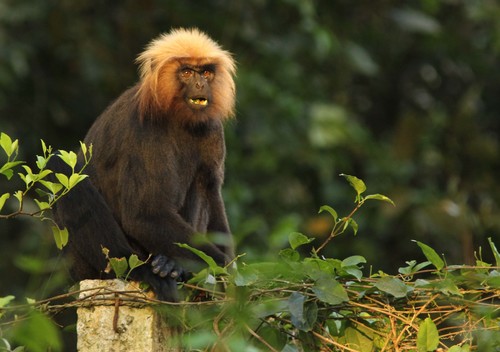
Nilgiri Langur
Semnopithecus johnii
Meet the 'Ghost of the Sholas,' a striking black-furred primate with a golden crown found only in the mist-covered mountains of South India. This rare langur is a master of the canopy, known for its incredible leaps and haunting vocalizations.
Quick Identification
Size
Head-body length 58–78 cm (23–31 in), tail 68–97 cm (27–38 in), weight 9–15 kg (20–33 lbs)
Colors
Lustrous jet-black body fur; distinct golden-brown or yellowish mane around the head and neck. Females feature a small, diagnostic white patch on the inner thighs.
Key Features
- Shaggy golden-brown crown contrasting with black body
- Long tail exceeding body length
- White inner-thigh patch on females
- High-pitched 'whooping' vocalization
When You’ll See Them
Geographic range
Where Does the Nilgiri Langur Live?
Native to the southern tip of the Asian continent, the Nilgiri Langur is an endemic species found exclusively in the Western Ghats of South India. Its core range spans the Nilgiri Hills across the states of Tamil Nadu, Kerala, and Karnataka, thriving in the moisture-rich shola forests and evergreen tracts of this mountain range. Because it is a habitat specialist restricted to these high-altitude and montane forests, it has no introduced populations elsewhere in the world.
Basemap © OpenStreetMap contributors
Behavior
The Nilgiri Langur is a highly arboreal primate that spends most of its life in the canopy. They are social creatures, typically living in groups, or troops, led by a dominant male accompanied by several females and their young. They are known for their spectacular agility, leaping through the treetops with ease and often covering significant distances between branches using their long tails for balance.
Communication within the troop is complex, involving various vocalizations, most notably the loud, resonant 'whoop' call of the adult male used to define territory and keep the group together. While naturally shy and elusive around humans, they have become somewhat habituated in areas where plantations or gardens border protected forests. In these fringe zones, they may occasionally venture onto the ground to cross gaps in the canopy, though they much prefer the safety of the heights.
EverydayEarth exclusive
Camera Tips
To capture the Nilgiri Langur, height is your best friend. Since these monkeys are primarily canopy-dwellers, a standard ground-level trail camera will likely only catch them if they are crossing between forest patches on the ground. Instead, aim to mount your camera 10 to 20 feet up in a sturdy tree that borders a clear flight path or a known fruiting tree. Angle the camera slightly downward to capture the full profile of the langur as it moves along branches.
While we don't recommend baiting wild primates, placing your camera near natural attractants like wild nutmeg or ficus trees during their fruiting season is highly effective. If you live in an area where they frequent backyard gardens or plantations, look for 'superhighways'—specific branches or rooflines they use daily to navigate. Langurs are creatures of habit and will often follow the same route to their favorite sleeping or feeding trees.
For settings, use a high shutter speed or a dedicated 'fast motion' mode. These monkeys are incredibly quick, especially when leaping, and a standard setting may result in a black blur. Because of their glossy black fur, they can be difficult to expose correctly; if your camera allows, a slight overexposure can help bring out the details of their fur texture and mane in deep forest shade.
Finally, utilize the time-lapse feature if the camera is positioned near a suspected feeding site. Nilgiri Langurs spend a significant portion of their morning and late afternoon foraging and grooming. Capturing these social interactions provides much more compelling footage than a simple motion-triggered clip of a monkey moving past the lens.
Similar Species
Species that look similar or are commonly confused with Nilgiri Langur.
Frequently Asked Questions
Record Nilgiri Langur at your habitat
Connect a camera to start building your own species record — AI identifies every visitor automatically.