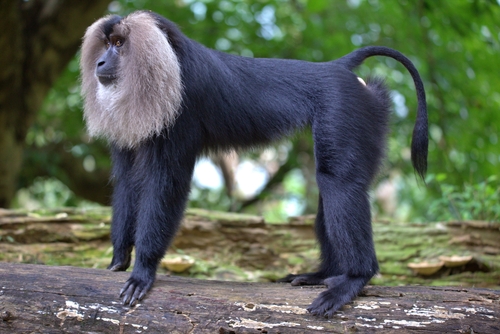
Lion-tailed Macaque
Macaca silenus
Meet the 'Lion' of India's rainforests. With its striking silver mane and tufted tail, this endangered primate is a rare icon of the Western Ghats' ancient canopy.
Quick Identification
Size
42–61 cm (16.5–24 in) in length, with a tail of 24–38 cm (9–15 in); weight ranges from 5–10 kg (11–22 lbs).
Colors
Glossy jet-black fur across the body, highlighted by a massive silver-white mane encircling the face. Both sexes look similar, though males are larger.
Key Features
- Majestic silver-white ruff or mane around the face
- Black tufted tail resembling a lion's tail
- Glossy black body fur
- Arboreal build with powerful limbs for climbing
When You’ll See Them
Geographic range
Where Does the Lion-tailed Macaque Live?
The Lion-tailed Macaque is a rare treasure found exclusively in the Western Ghats mountain range of South India. Its native range is highly restricted to the states of Karnataka, Kerala, and Tamil Nadu, where it inhabits isolated pockets of undisturbed evergreen forest. Because they are canopy specialists, they are strictly limited to regions where the forest remains thick and continuous, making them one of the most geographically restricted primates in the world.
Basemap © OpenStreetMap contributors
Behavior
The Lion-tailed Macaque is a highly social and predominantly arboreal primate. They live in hierarchical groups of 10 to 20 individuals, typically consisting of one dominant male and several females with their offspring. Unlike many other macaque species that spend significant time on the ground, these monkeys are masters of the upper canopy, rarely descending unless the forest cover is fragmented. They are diurnal, spending their mornings foraging and their afternoons engaged in social grooming, which is vital for troop cohesion.
While they are naturally shy and elusive, they have a complex communication system. They use a variety of vocalizations, most notably a soft 'coo' call to maintain contact while foraging in dense foliage. In areas where their habitat overlaps with human agriculture, such as tea and coffee plantations, they may be seen crossing roads or using man-made structures to navigate between forest patches, though they generally remain much more reclusive than the common Bonnet Macaque.
EverydayEarth exclusive
Camera Tips
Capturing the Lion-tailed Macaque on a trail camera requires a specialized 'canopy-level' approach. Because they are strictly arboreal, a ground-mounted camera will likely only capture passing shadows or the occasional descent in fragmented areas. For the best results, mount your camera at heights of 15 to 30 feet within the mid-to-upper canopy. Target 'wildlife corridors' or canopy bridges—specific spots where the branches of giant trees like the Cullenia exarillata or Ficus overlap—as these serve as the macaques' primary highways through the forest.
Seasonality plays a major role in camera placement. During the fruiting season of the Cullenia tree (typically the monsoon and post-monsoon months), focus your lenses on these specific food sources. The macaques will return to the same fruiting trees for days at a time. Using a 'no-glow' infrared flash is critical for this species; they are intelligent and cautious, and a visible red glow from a standard infrared flash can spook the troop and alter their natural foraging patterns.
For settings, prioritize a high trigger speed (under 0.3 seconds) and a multi-shot burst mode. Macaques move quickly and sporadically through branches, and a slow camera will often result in nothing but a blurry tail. High-definition video is particularly effective for this species, as it allows you to capture the social interactions and the movement of their silver manes, which are their most identifying features. Ensure your camera is angled slightly downward from its mount to capture the monkeys as they move across horizontal limbs.
Similar Species
Species that look similar or are commonly confused with Lion-tailed Macaque.
Frequently Asked Questions
Record Lion-tailed Macaque at your habitat
Connect a camera to start building your own species record — AI identifies every visitor automatically.