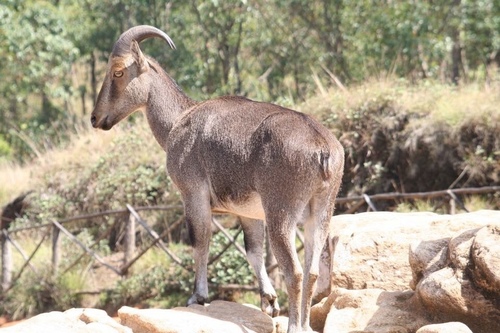
Nilgiri Tahr
Nilgiritragus hylocrius
Experience the 'Mountain Monarch' of Southern India. The Nilgiri Tahr is a master of the mist-covered peaks, known for its incredible climbing skills and the striking silver backs of the mature males.
Quick Identification
Size
Height: 80-100 cm (31-39 in) at the shoulder; Weight: 80-100 kg (176-220 lbs) for males, 50 kg (110 lbs) for females.
Colors
Adult males are dark chocolate brown to black with a prominent silvery-white 'saddle' patch. Females and juveniles are grayish-brown.
Key Features
- Curved, backward-sweeping horns with a flattened inner surface
- Distinctive silvery-white 'saddle' patch on mature males
- Sturdy build with short, strong legs adapted for vertical cliffs
- Pale facial stripes and light patches on the knees
When You’ll See Them
Geographic range
Where Does the Nilgiri Tahr Live?
This rare ungulate is native to the southern Asian continent, specifically confined to a narrow strip of the Western Ghats mountain range in India. Its core range is restricted to the states of Tamil Nadu and Kerala, with the largest surviving populations found in the Nilgiri Hills and the Anaimalai Hills. Because they are specialized high-altitude dwellers, their habitat is fragmented into isolated 'islands' of montane grassland surrounded by tropical forests.
Basemap © OpenStreetMap contributors
Behavior
The Nilgiri Tahr is a highly social mountain ungulate, typically found in herds of 10 to 50 individuals, though larger groups are occasionally seen. They are remarkably agile, capable of navigating near-vertical cliffs to escape predators like leopards and tigers. Within the herd, adult 'Saddleback' males maintain a hierarchy through displays of strength, while females and their young form the stable, social core of the group.
These animals are primarily diurnal, meaning they are most active during daylight hours. They spend their mornings and late afternoons grazing on the steep grassy slopes, often retreating to the safety of rocky crags during the midday heat or when threatened. While generally shy of humans, populations in protected areas like Eravikulam National Park have become somewhat accustomed to quiet observers, though they remain wild and highly alert.
EverydayEarth exclusive
Camera Tips
Capturing the Nilgiri Tahr on camera requires positioning equipment at high-altitude transition zones where grassy slopes meet rocky precipices. These animals use established cliff-side trails to move between feeding grounds and bedding sites. Mount your camera 3-4 feet off the ground, angled slightly upward if placed at the base of a slope, or level if positioned on a flat ridge looking across a valley. Ensure the housing is rugged and weather-sealed, as the Western Ghats experience heavy mist and intense monsoon rains that can easily damage standard electronics.
Because they are herbivores in a protected and sensitive ecosystem, using bait is not recommended and often illegal. Instead, focus on natural 'salt licks' or small rocky springs where they gather to drink during the dry months. The best results come from placing cameras near 'escape terrain'—the steep, rocky areas they run to when startled. Setting your camera to a fast trigger speed (0.3s or less) is essential, as these animals can move with surprising bursts of speed across uneven ground even when they aren't spooked.
Timing is everything for the best lighting and activity. Set your camera to be most sensitive during the 'golden hours' of dawn and dusk when the Tahr are most active in the open. In the misty Nilgiris, a high-quality PIR (Passive Infrared) sensor is vital to distinguish the tahr's body heat from the moving fog and wind-blown grass. Use a wide-angle lens if possible to capture the dramatic landscape; the Tahr's presence is often best told through its relationship with the towering cliffs of the Western Ghats.
Similar Species
Species that look similar or are commonly confused with Nilgiri Tahr.
Frequently Asked Questions
Record Nilgiri Tahr at your habitat
Connect a camera to start building your own species record — AI identifies every visitor automatically.