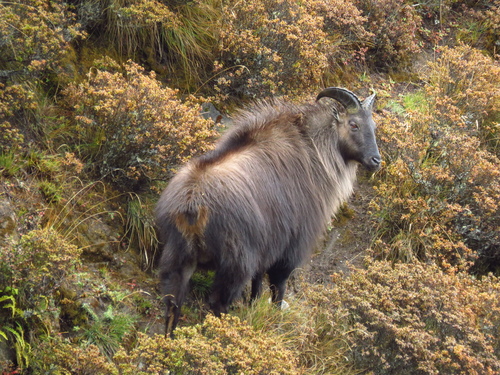
Himalayan Tahr
Hemitragus jemlahicus
A master of the vertical world, the Himalayan Tahr is an iconic mountain goat-antelope known for its shaggy mane and gravity-defying climbing skills. Encountering one against the backdrop of the world's highest peaks is an unforgettable wildlife experience.
Quick Identification
Size
Length 90–140 cm (35–55 in); weight 36–90 kg (79–198 lbs)
Colors
Shaggy reddish-brown to dark brown coats; males develop a thick manelike ruff on the neck and shoulders; pale undersides.
Key Features
- Short, backward-curving triangular horns
- Thick shaggy mane on males during winter
- Sturdy build with relatively short legs and rubbery hoof cores
- Small head with large eyes and pointed ears
When You’ll See Them
Geographic range
Where Does the Himalayan Tahr Live?
The Himalayan Tahr is native to the majestic mountain ranges of Asia, specifically inhabiting the rugged slopes of the Himalayas across southern Tibet, northern India, Nepal, and western Bhutan. They thrive in the high-altitude transition zones between forests and alpine meadows. Beyond their native range, successful introduced populations have established themselves in the Southern Alps of New Zealand, the Table Mountain range in South Africa, and localized areas of New Mexico and California in the United States.
Basemap © OpenStreetMap contributors
Behavior
Himalayan Tahrs are social animals, typically found in groups that vary by season and gender. During most of the year, adult males often live in bachelor groups or remain solitary, while females and young form larger herds. They are incredibly agile, spending their days navigating near-vertical cliffs and rocky crags with ease, using their specialized hooves to grip steep surfaces where predators struggle to follow.
These ungulates are primarily crepuscular, meaning they are most active during the cooler hours of the early morning and late afternoon. When not grazing, they retreat to the safety of higher rocky ledges to rest and ruminate. While generally shy of humans, they have become somewhat habituated to trekkers in popular Himalayan regions, though they remain alert and will emit a shrill whistle to warn the herd of approaching danger.
EverydayEarth exclusive
Camera Tips
To capture the Himalayan Tahr, camera placement is everything. Since these animals are masters of vertical terrain, position your camera at the intersection of rocky outcrops and established game trails. Look for 'shelves' on cliff faces or narrow passes that connect feeding grounds to bedding areas. Angle your camera slightly downward if placing it on a slope to ensure you catch the full body rather than just the legs or back. In introduced ranges like New Zealand, they are often found near mineral licks or salt blocks, which can serve as an excellent natural lure.
Timing and lighting are crucial for high-altitude photography. Set your camera to trigger most frequently during the 'golden hours'—the two hours after sunrise and the two hours before sunset. This is when tahrs are most active and the light beautifully highlights their shaggy coats. Because the Himalayan sun can be harsh and create deep shadows on rocky terrain, using a camera with a high dynamic range (HDR) setting or adjustable exposure can prevent the dark brown fur from washing out against bright snow or grey limestone.
For the best visual results, target the late autumn and winter months. This is when the males grow their spectacular, lion-like manes and the dark fur contrasts brilliantly against snowy backdrops. Use a fast shutter speed or a multi-shot burst mode; despite their bulky appearance, tahrs can move with surprising speed when spooked or during the rut. If you are setting up in a backyard or property that borders mountain wilderness, avoid using artificial scents, as these wary animals rely heavily on their sense of smell to detect intruders.
Similar Species
Species that look similar or are commonly confused with Himalayan Tahr.
Markhor
Markhor have much larger, corkscrew-shaped horns and a lighter coat compared to the Tahr's compact, backward-curving horns.
Mountain Goat
Mountain Goats are easily distinguished by their stark white coats and thinner, upright black horns.
Nilgiri Tahr
The Nilgiri Tahr lives in southern India, has shorter hair, and lacks the long, shaggy neck mane characteristic of the Himalayan species.
Frequently Asked Questions
Record Himalayan Tahr at your habitat
Connect a camera to start building your own species record — AI identifies every visitor automatically.