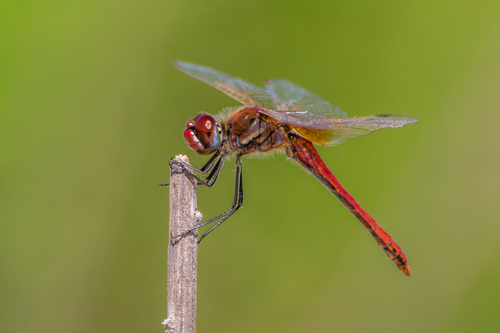
Nomad
Sympetrum fonscolombii
True to its name, the Nomad is a world traveler that brings a splash of scarlet to backyards across the globe. With its striking red-veined wings and bold personality, this dragonfly is a favorite for garden observers and macro photographers alike.
Quick Identification
Size
Length: 38–40 mm (1.5–1.6 inches); Wingspan: 58–62 mm (2.3–2.4 inches)
Colors
Males are striking scarlet-red with red-veined wings; females and juveniles are golden-yellow with black markings on the abdomen. Both sexes feature distinct blue-gray undersides to their eyes.
Key Features
- Vivid red wing veins especially near the wing base
- Lower half of eyes are a distinct blue-gray
- Small yellow-saffron patch at the base of the hind wings
- Prominent black 'stitched' markings on the side of the abdomen
When You’ll See Them
Behavior
The Nomad, also known as the Red-veined Darter, is one of the most wanderlust-filled dragonflies in the world. Unlike many species that remain tethered to a single pond, the Nomad is highly migratory, often traveling hundreds of miles to colonize new, even temporary, bodies of water. They are agile and powerful fliers, frequently seen darting over open ground or hovering expertly near the water's edge.
In a garden setting, they are generally bold and less skittish than other darters. You will often find them perching on low-lying vegetation, bare patches of earth, or even garden furniture to soak up the sun. This sun-basking behavior is critical for their survival, as it helps them maintain the high body temperatures required for their energetic hunting flights and territorial defense.
EverydayEarth exclusive
Camera Tips
To successfully capture the Nomad on your backyard camera, you must focus on their preferred perching spots. Unlike birds that might visit a feeder, dragonflies are creatures of habit that return to the same twig or stem repeatedly to survey their territory. Place your camera on a tripod or mount it just 12 to 24 inches from the ground, pointing at a prominent, sun-exposed branch or a tall reed near a water source. If you don't have a pond, a simple bamboo stake placed in an open, sunny part of the garden acts as an irresistible "perch lure" for these insects.
Because these dragonflies are relatively small and fast, a standard trail camera might struggle with focus. If possible, use a camera with a macro mode or a close-focusing distance of at least 1-2 feet. Set your trigger speed to the highest possible sensitivity. A fast shutter speed is essential; if your camera allows manual overrides, aim for 1/1000s or faster to freeze the motion of those intricate red wing veins. Position the camera so the sun is behind you or hitting the subject from the side; this highlights the translucent nature of the wings and the vibrancy of the red body.
Try using a "Burst" or "Photo Series" mode rather than a single shot. Dragonflies often hover for a split second before landing or taking off, and these frames are often more dramatic than a static perched shot. If your camera has a "Pre-roll" or "Pro-capture" feature, enable it—this saves the moments just before the motion trigger, which is the perfect way to catch that explosive, high-speed takeoff.
Temperature and timing are the final pieces of the puzzle. On cool mornings, Nomads are more lethargic and will sit still for longer periods as they wait for the sun to warm their wing muscles. Aim your setup for the 9:00 AM to 11:00 AM window for the best balance of cooperative subjects and soft, golden light. If you're using an AI-powered camera, ensure the "small animal" or "insect" detection mode is active, as their thin profile can sometimes be missed by sensors calibrated for larger mammals.
Similar Species
Species that look similar or are commonly confused with Nomad.
Frequently Asked Questions
Record Nomad at your habitat
Connect a camera to start building your own species record — AI identifies every visitor automatically.