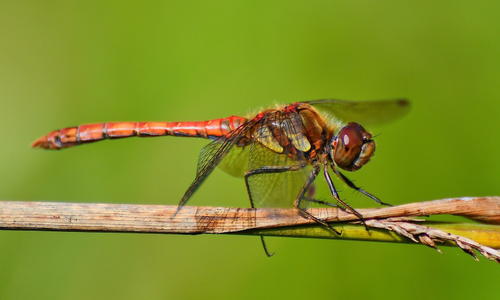
Common Darter
Sympetrum striolatum
The Common Darter is the late-summer sentinel of the garden, a brilliant red or golden-brown dragonfly that loves to bask in the sun. Known for its 'sit-and-wait' hunting style, it is one of the most approachable and frequently photographed insects in Eurasia.
Quick Identification
Size
Length 38–43 mm (1.5–1.7 in); Wingspan 55–60 mm (2.2–2.4 in)
Colors
Males are bright orange-red; females and immature males are golden-yellow or light brown. Both have distinct yellow stripes on their legs.
Key Features
- Yellow or cream stripes running down the length of otherwise black legs
- Bright red (male) or golden-brown (female) cylindrical abdomen
- Small black 'mustache' on the face that does not extend down the sides of the eyes
- Habit of sitting flat on sun-warmed surfaces like stones or wood
When You’ll See Them
Geographic range
Where Does the Common Darter Live?
Where Does the Common Darter Live? This resilient dragonfly is native to the vast landmass of Eurasia, representing one of the most widely distributed Odonata species in the Old World. Its core range spans from the British Isles and Western Europe all the way across Russia to Japan and China, while extending southwards into North Africa and parts of the Middle East. Because they are highly adaptable to man-made water bodies, they thrive in suburban environments across Europe and Asia, often appearing in backyard gardens miles away from their original breeding ponds.
Basemap © OpenStreetMap contributors
Behavior
They are notably cold-tolerant compared to other dragonflies, often remaining active late into the autumn when other species have died off. On cooler days, you may see them tilting their bodies to maximize sun exposure or even landing on light-colored walls or human clothing to soak up residual warmth. During the breeding season, they are frequently seen flying in 'tandem,' where the male stays attached to the female to protect her from rivals while she lays eggs in the water.
EverydayEarth exclusive
Camera Tips
Because dragonflies are small, use a camera with a good macro setting or a close-focusing distance of about 1 to 2 feet. If your AI camera allows for 'zone triggering,' set the trigger area specifically around the top of a garden cane or a prominent stone. High shutter speeds are essential if you want to freeze their wings in motion, though capturing them while perched is much easier and allows for lower ISO settings and cleaner images.
Lighting is everything for this species. They are most active during the brightest, hottest parts of the day. Position your camera so the sun is behind you or to the side; backlighting can create a beautiful 'glow' through their translucent wings, but it can also wash out the vibrant reds and yellows of their bodies. If you don't have a natural perch, you can 'bait' them into a specific camera frame by placing a bamboo stake or a decorative flat stone in an open, sunny area near water.
Late summer and early autumn (August through September) are the prime months for recording. During this time, Common Darters become less flighty and more desperate for heat, meaning they will stay still on a perch for longer periods. If you are using a trail camera, look for models with a high frame rate (60fps or higher) to capture the incredible mechanics of their four-winged flight when they launch after prey.
Similar Species
Species that look similar or are commonly confused with Common Darter.
Ruddy Darter
The Ruddy Darter has completely black legs and a more blood-red, waisted abdomen compared to the striped legs of the Common Darter.
Vagrant Darter
Nearly identical, but the Vagrant Darter has black facial markings that extend down the side of the eyes, whereas the Common Darter's 'mustache' stops at the eye.
Southern Darter
Found in Southern Europe, this species has much less black on the thorax and generally paler markings on its legs.
Frequently Asked Questions
Record Common Darter at your habitat
Connect a camera to start building your own species record — AI identifies every visitor automatically.