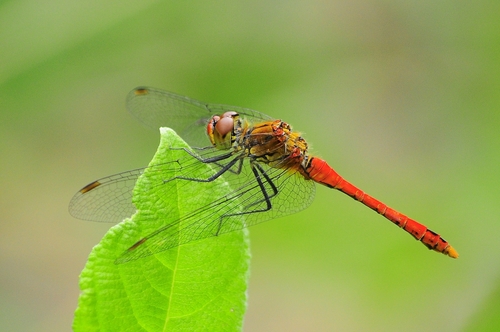
Ruddy Darter
Sympetrum sanguineum
With its striking blood-red body and jet-black legs, the Ruddy Darter is one of the most vivid summer visitors to the backyard pond. A master of the 'sit-and-wait' hunt, this small but fierce predator is a favorite for nature photographers.
Quick Identification
Size
Length: 34-36 mm (1.3-1.4 inches); Wingspan: 50-60 mm (2-2.4 inches)
Colors
Mature males are a brilliant blood-red; females and immature males are ochre-yellow. Both sexes have distinctive, entirely black legs.
Key Features
- Intense blood-red body in mature males
- Uniformly black legs with no yellow stripes
- Abdomen noticeably pinched or 'waisted' near the base
- Small dark patches at the base of the hindwings
When You’ll See Them
Behavior
The Ruddy Darter is a classic 'percher' dragonfly. Unlike hawker species that spend most of their time in flight, this dragonfly prefers to sit on a prominent twig, reed, or leaf, darting out to snatch passing prey before returning to the same spot. They are highly territorial, and males can often be seen aggressively defending their preferred perches from rivals.
During the heat of the day, you might see them performing an 'obelisk' posture—pointing their abdomen straight up toward the sun to minimize their surface area and prevent overheating. They are relatively approachable compared to other dragonflies, often allowing observers (and cameras) to get quite close if movements are slow and steady.
EverydayEarth exclusive
Camera Tips
To successfully capture the Ruddy Darter on camera, you must take advantage of their perching habit. Identify 'sentinel' spots—usually a dry stick, a tall reed, or the tip of a garden stake that stands higher than the surrounding vegetation near a pond. If your garden lacks these, 'plant' a few bamboo canes at various heights. These dragonflies are creatures of habit and will return to the same perch dozens of times a day, allowing you to pre-focus your camera on that specific point.
For the best lighting, position your camera with the sun behind it or at a 45-degree angle. This illuminates the male's vibrant red pigment, making it pop against green backgrounds. Since these insects are small, use a camera with a macro lens or a close-focusing feature, mounting it roughly 12 to 24 inches from the chosen perch. High-speed shutter settings are essential if you want to freeze their wings in flight, though a perched shot is much easier to achieve with motion-activated AI cameras.
Consider the background when placing your camera. A 'busy' background with lots of moving grass can trigger false recordings and make the dragonfly harder to see. Aim for a setup where the perch is several feet away from any distant foliage to create a soft, blurred background that highlights the insect's intricate wing veins and body color. If you are tracking breeding behavior, mount a camera low to the ground near the water's edge to capture 'tandem' pairs laying eggs in the mud.
Similar Species
Species that look similar or are commonly confused with Ruddy Darter.
Frequently Asked Questions
Record Ruddy Darter at your habitat
Connect a camera to start building your own species record — AI identifies every visitor automatically.