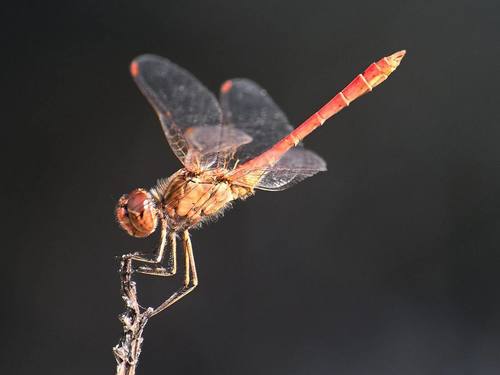
Southern Darter
Sympetrum meridionale
A sun-loving master of the skies, the Southern Darter is recognized by its warm red tones and remarkably pale, clean features. Often found basking in backyard gardens, it is one of the most approachable dragonflies for nature photographers and AI enthusiasts alike.
Quick Identification
Size
Length 35–40 mm (1.4–1.6 in); Wingspan 55–60 mm (2.2–2.4 in)
Colors
Males have a pale red to orange-red abdomen and a plain yellow-brown thorax; females and juveniles are sandy-yellow/ochre. Both have notably pale, straw-colored legs.
Key Features
- Thorax sides are almost entirely pale with very faint black suture lines
- Legs are predominantly yellow with only thin black stripes
- Small black dots present on the sides of abdominal segments 4 through 9
- Enlarged yellow patches at the very base of the wings
When You’ll See Them
Geographic range
Where Does the Southern Darter Live?
The Southern Darter is native to the warm regions of Southern Europe, North Africa, and Western Asia. Its core population density is found across the Mediterranean basin, including Spain, Italy, Greece, and Turkey, but it is a highly mobile species known for northward expansion. In recent decades, it has become increasingly common in Central Europe and is a frequent migrant to the United Kingdom and the Benelux countries, thriving in areas with hot summers and shallow wetlands.
Basemap © OpenStreetMap contributors
Behavior
The Southern Darter is a classic 'percher' dragonfly, spending much of its day sitting on low-hanging vegetation, tall grasses, or even the bare ground. From these vantage points, it surveys the area for small flying insects. When prey is spotted, it performs a lightning-fast aerial sortie to snatch the insect out of the sky before returning to the same or a nearby perch. This repetitive 'darting' behavior is a hallmark of the Sympetrum genus and makes them excellent subjects for observation.
Unlike many other dragonflies that are highly territorial and aggressive, Southern Darters are relatively social and can often be found in large, loose groups, especially in late summer when they wander away from their breeding ponds. They are most active during the hottest parts of the day and are particularly fond of basking in the sun to regulate their body temperature. Toward the end of the season, they are known for their dispersal flights, which can lead them miles away from the nearest water source and into suburban backyard environments.
EverydayEarth exclusive
Camera Tips
To successfully capture the Southern Darter on an AI camera, you must think like a percher. These dragonflies look for the highest or most prominent 'lookout' in a sunny area. You can create a 'perch trap' by placing a vertical bamboo stake or a slender stick in an open, sun-drenched part of your garden. Position your camera lens approximately 12 to 20 inches from the top of the stick, as this is where the dragonfly is most likely to land. Ensure the background is distant to create a soft blur that helps the AI identify the insect's sharp silhouette.
Timing is critical for this species. Unlike mammals that might visit at dawn, the Southern Darter waits for the sun to high-step into the sky. Configure your camera's active hours for 10 AM to 5 PM. Because they are cold-blooded, they will spend long periods sitting still on their perch to soak up heat, providing the perfect opportunity for high-resolution stills. If your camera supports it, use a high frame rate for video, as their take-off and landing sequences happen in a fraction of a second.
Seasonal placement varies for this species. During June and July, focus your efforts near the edges of ponds or damp ditches. However, by August and September, the Southern Darter often moves into drier areas. During these months, move your camera to the middle of a flower garden or a sun-baked patio. They are particularly attracted to pale-colored surfaces that reflect heat. Avoid placing the camera in the shade, as these insects will almost always choose the sunniest spot available to rest.
Similar Species
Species that look similar or are commonly confused with Southern Darter.
Frequently Asked Questions
Record Southern Darter at your habitat
Connect a camera to start building your own species record — AI identifies every visitor automatically.