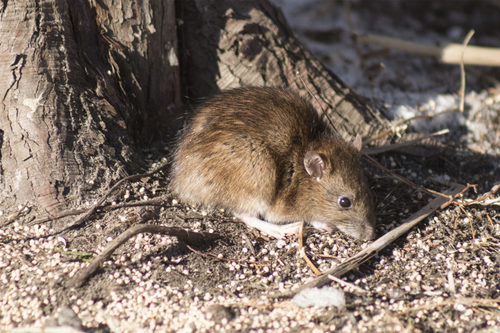
Northeastern Marsh Rice Rat
Oryzomys palustris
A master of the wetlands, the Marsh Rice Rat is a sleek, semiaquatic rodent that navigates the tides with ease. This expert swimmer is the unsung acrobat of the American salt marsh.
Quick Identification
Size
Total length: 9-12 inches (22-30 cm); Weight: 1.4-2.8 oz (40-80 g)
Colors
Gray-brown upperparts with grizzled black hairs; creamy white to pale gray underparts; tail is bicolored, dark above and light below
Key Features
- Long, hairy tail nearly equal to body length
- Dense, water-repellent fur
- Hind feet with small webs and fringes of hair for swimming
- Small, inconspicuous ears nearly buried in fur
When You’ll See Them
Geographic range
Where Does the Northeastern Marsh Rice Rat Live?
Native to the North American continent, the Marsh Rice Rat is a staple of the eastern and southern United States coastal and wetland ecosystems. Its range spans from the tidal marshes of New Jersey and Delaware, extending southward through the Florida peninsula and reaching west into the Gulf Coast regions of Texas and as far inland as Kansas. These rodents are strictly tied to water-rich environments, rarely appearing in dry upland habitats far from a marsh or swamp edge.
Basemap © OpenStreetMap contributors
Behavior
The Marsh Rice Rat is a highly specialized semiaquatic rodent, possessing a unique set of skills that allow it to thrive in the challenging environment of tidal marshes and swamps. They are exceptional swimmers and divers, often taking to the water to escape predators or to hunt for aquatic prey. While they are primarily nocturnal, they are occasionally active during the day, especially in areas with very dense overhead cover.
These rats are generally solitary and maintain small home ranges. They construct sophisticated nests—either globular grass structures woven into high marsh vegetation or burrows dug into banks above the high-tide line. Despite their resemblance to common pests, they are a vital part of the wetland food web, serving as both a predator of invertebrates and a primary food source for owls, hawks, and minks.
EverydayEarth exclusive
Camera Tips
To capture the Marsh Rice Rat on camera, location is everything. Focus your efforts on the 'transition zone'—the area where dense marsh grass meets the mudflats or open water. Look for narrow, well-trodden 'runways' through the grass or small tunnels at the base of reeds. Mount your camera very low, ideally only 4 to 6 inches off the ground, and angle it slightly downward to catch their low-profile scurrying behavior.
Because these rats are primarily nocturnal and have pale underparts, infrared (IR) flash can sometimes cause 'white-out' on the image. To counter this, try to position the camera at a 45-degree angle to the expected path of travel rather than head-on. If you are filming in a tidal area, always check tide charts and mount your camera on a tall stake well above the maximum high-tide line to prevent equipment damage while still aiming the lens at the lower foraging grounds.
Baiting is highly effective for this species. Use a mixture of peanut butter and canned sardines or tuna smeared on a log or a flat rock within the camera's field of view. This high-protein lure is irresistible to an omnivorous marsh specialist and will encourage the rat to pause long enough for a clear, high-resolution photo. During the summer, look for activity around fruiting marsh plants, which can be natural hotspots for movement.
Similar Species
Species that look similar or are commonly confused with Northeastern Marsh Rice Rat.
Frequently Asked Questions
Record Northeastern Marsh Rice Rat at your habitat
Connect a camera to start building your own species record — AI identifies every visitor automatically.