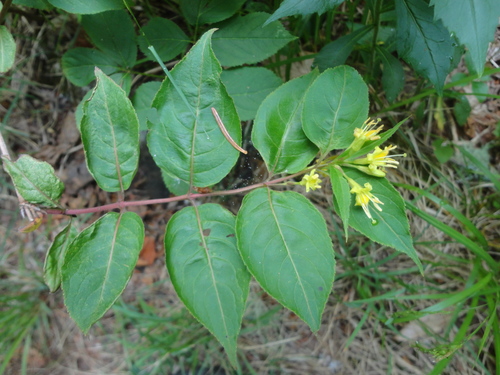
northern bush honeysuckle
Diervilla lonicera
A resilient native shrub that bridges the gap between forest and field, the northern bush honeysuckle is a pollinator powerhouse known for its color-changing flowers and brilliant autumn leaves.
Quick Identification
Size
60–120 cm (2–4 ft) in height with a similar spread
Colors
Dark green leaves that turn reddish-bronze or deep purple in fall; pale yellow flowers that mature to orange or reddish-brown
Key Features
- Low-growing, mounded deciduous shrub
- Opposite, lance-shaped leaves with finely serrated edges
- Trumpet-shaped yellow flowers that change color after pollination
- Fruit is a dry, beaked capsule rather than a berry
When You’ll See Them
Geographic range
Where Does the northern bush honeysuckle Live?
Native to North America, the northern bush honeysuckle is widely distributed across the northeastern United States and much of central and eastern Canada. Its core territory stretches from the Atlantic coast of Newfoundland westward to Saskatchewan, reaching as far south as North Carolina and Tennessee along the higher elevations of the Appalachian Mountains. It is a quintessential plant of the Great Lakes region and the transition forests of New England, where it thrives in both sun-drenched clearings and partially shaded woodland borders.
Basemap © OpenStreetMap contributors
Behavior
Northern bush honeysuckle is a hardy, colony-forming deciduous shrub that spreads primarily through underground rhizomes. Unlike many of its invasive relatives in the Lonicera genus, this native species is well-behaved and rarely crowds out other native flora. It is highly resilient, often serving as a pioneer species in areas with poor, rocky, or sandy soils where other plants might struggle to take root.
During its blooming phase in late spring and early summer, the shrub becomes a focal point for local ecology. It has a fascinating relationship with bumblebees, which are its primary pollinators. As the flowers are successfully pollinated, they undergo a visible color shift from pale yellow to a deep orange or red, signaling to insects that the nectar supply has been depleted. This efficient communication system ensures that pollinators focus their energy on unpollinated flowers.
EverydayEarth exclusive
Camera Tips
To capture the dynamic life surrounding a northern bush honeysuckle, position your AI-powered camera about 2 to 3 feet off the ground. Since this is a low-growing, mounded shrub, an eye-level or slightly downward-tilted angle is best for framing the flower clusters where most of the action happens. If your camera allows for close-up or macro focusing, place it within 18 to 24 inches of a healthy flower patch to catch the intricate details of visiting bumblebees and clearwing moths.
Lighting is the most important factor for plant photography. Choose a specimen located on a forest edge where it receives dappled morning light or late afternoon sun. This 'golden hour' illumination will make the yellow trumpets pop against the dark green foliage. Using a time-lapse setting is highly recommended during the peak bloom weeks of June and July; this allows you to record the fascinating color transition of the flowers from yellow to orange over several days, which is a clear indicator of pollination activity.
While the insects are the main attraction, don't overlook the potential for larger visitors. The dense, low-growing branches of the northern bush honeysuckle provide excellent cover for ground-nesting birds and small mammals like chipmunks. Setting your camera to a high-sensitivity motion trigger during the early morning hours can help you capture these shy creatures as they move through the undergrowth. In late autumn, the vibrant reddish foliage makes for a stunning backdrop, so keep your cameras running even after the flowers have faded to capture the seasonal transition.
Similar Species
Species that look similar or are commonly confused with northern bush honeysuckle.
Frequently Asked Questions
Record northern bush honeysuckle at your habitat
Connect a camera to start building your own species record — AI identifies every visitor automatically.