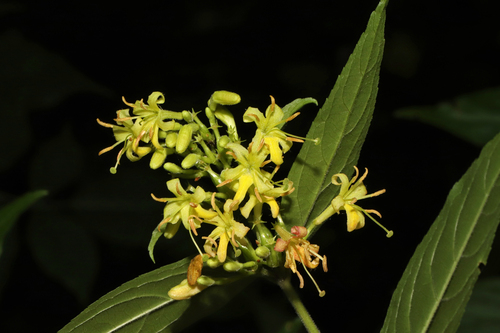
mountain bush honeysuckle
Diervilla rivularis
A rare treasure of the Southern Appalachians, the mountain bush honeysuckle provides a golden display of summer blooms and velvety foliage. This non-invasive shrub is an essential sanctuary for native bees and hummingbirds.
Quick Identification
Size
A compact, mounding shrub reaching 3–6 feet (0.9–1.8 m) in height and width.
Colors
Bright green foliage with a velvety appearance; flowers are sulfur-yellow, often aging to orange or reddish-bronze; stems are often reddish-brown.
Key Features
- Densely hairy (pubescent) stems and leaf undersides
- Opposite, ovate leaves with finely serrated margins and pointed tips
- Clusters of sulfur-yellow, trumpet-shaped flowers at branch ends
- Non-invasive, mounding growth habit unlike vine-based honeysuckles
When You’ll See Them
Geographic range
Where Does the mountain bush honeysuckle Live?
Native to the southeastern United States, this species is a specialist of the southern Appalachian Mountains. Its primary range is remarkably narrow, concentrated in the mountainous regions of Alabama, Georgia, and Tennessee. While it was historically documented in North Carolina, it is now considered extirpated from that state, making its remaining populations in the tri-state area ecologically significant.
Basemap © OpenStreetMap contributors
Behavior
Mountain bush honeysuckle is a resilient deciduous shrub that exhibits a slow-growing, non-aggressive behavior, making it a well-behaved neighbor in Appalachian ecosystems. Unlike its invasive cousins, it does not climb or choke out other plants; instead, it forms dense, tidy mounds that provide excellent low-level cover for small mammals and ground-nesting birds. The plant is particularly noted for its bloom cycle, where its flowers undergo a color shift after pollination, signaling to insects that nectar resources have been spent.
This species is highly adapted to the rugged conditions of the Southern Appalachians, showing a preference for rocky soils where other plants might struggle. In a garden or backyard setting, it acts as a primary hub for pollinator activity during the mid-summer months. It is not known to be toxic to humans and generally coexists peacefully with suburban development, provided its specific soil and elevation needs are met.
EverydayEarth exclusive
Camera Tips
To successfully capture the mountain bush honeysuckle on a trail camera, focus on the 'pollinator window' during the peak blooming months of June through August. Position your camera on a sturdy stake or tripod approximately 3 feet off the ground, pointing slightly downward at the terminal flower clusters. Because the branches are flexible and prone to swaying in mountain breezes, avoid mounting the camera directly to the shrub; a separate mount will prevent the 'false triggers' caused by wind-blown foliage.
For high-quality imagery, use a camera with a fast trigger speed and high-resolution video capabilities. The yellow flowers attract hummingbirds and large bumblebees, which move incredibly fast. Setting your camera to 'Burst Mode' or 'High-Speed Video' (60fps or higher) will help you freeze the motion of these visitors. If your camera allows for focal adjustments, set it for a close-up range (3-5 feet) to highlight the distinct 'hairy' texture of the leaves and stems that give the plant its name.
Lighting is crucial for this species. Aim for a spot that receives bright, indirect morning sun. The sulfur-yellow petals can easily become 'blown out' or overexposed in harsh midday light, so positioning the camera to face north or east often yields the most balanced colors. If you are using an AI-powered camera like those supported by EverydayEarth, the distinct flower shape and leaf pattern will be most easily identified during the peak of the day when the yellow contrast against the green leaves is highest.
Similar Species
Species that look similar or are commonly confused with mountain bush honeysuckle.
Southern Bush Honeysuckle
Very similar but lacks the dense hairs on the leaves and stems found on the mountain variety.
Northern Bush Honeysuckle
Found much further north; it has smoother leaves and smaller flower clusters.
Japanese Honeysuckle
An invasive vine with white/yellow flowers that climbs trees, unlike the mounding shrub form of the mountain bush honeysuckle.
Frequently Asked Questions
Record mountain bush honeysuckle at your habitat
Connect a camera to start building your own species record — AI identifies every visitor automatically.