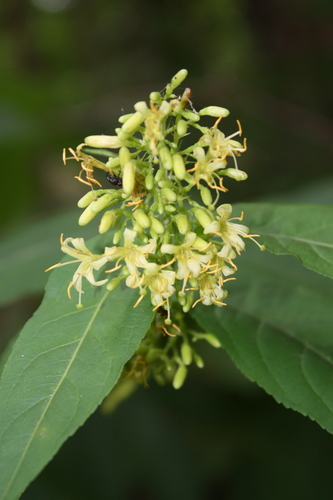
Southern bush honeysuckle
Diervilla sessilifolia
A resilient mountain native, the Southern bush honeysuckle brightens the Appalachian highlands with its sulfur-yellow summer blooms and striking autumn color.
Quick Identification
Size
3–5 feet (0.9–1.5 meters) in height and spread
Colors
Bright green lance-shaped leaves; sulfur-yellow tubular flowers; reddish-bronze autumn foliage; reddish-purple new stem growth
Key Features
- Sessile leaves attached directly to the stem without stalks
- Square-shaped young stems
- Clusters of trumpet-shaped sulfur-yellow flowers
- Deciduous mounding shrub habit
When You’ll See Them
Geographic range
Where Does the Southern bush honeysuckle Live?
The Southern bush honeysuckle is a distinctive native of the Southeastern United States, primarily concentrated in the southern Appalachian Mountains. Its natural range is most robust within the high-elevation forests and rocky outcrops of North Carolina, Tennessee, Georgia, and Alabama. While it is a regional specialist, it is increasingly cultivated in native plant gardens across the Eastern U.S. for its durability and pollinator value.
Basemap © OpenStreetMap contributors
Behavior
The Southern bush honeysuckle is a hardy, colony-forming shrub that plays a vital role in its native Appalachian ecosystem. Unlike the invasive Asian honeysuckles that plague many backyards, this native species is non-aggressive and serves as a critical resource for local wildlife. It spreads slowly via underground rhizomes, creating dense, low-growing thickets that offer excellent nesting sites and thermal cover for ground-dwelling birds and small mammals.
During its summer blooming period, the shrub becomes a hub of activity for specialized pollinators. Its nectar-rich flowers are specifically evolved to accommodate bumblebees and butterflies, which are attracted to the bright yellow blooms. In the garden, it is appreciated for its ability to thrive in poor, rocky soils and its natural resistance to deer, making it a reliable choice for woodland edge restoration.
EverydayEarth exclusive
Camera Tips
To successfully capture the Southern bush honeysuckle on an AI-powered trail camera, focus your efforts on the tips of the branches where the flower clusters emerge. Set your camera on a short tripod or stake approximately 3 feet off the ground. Angling the lens slightly downward will allow you to capture the distinct 'sessile' leaf attachments and the square stems, which are vital for accurate AI species identification.
Because this shrub thrives in the dappled light of woodland edges, positioning is key to avoid overexposure. Avoid facing the camera directly East or West; instead, aim for a North-facing orientation to ensure even, soft lighting throughout the day. This setup is particularly effective for recording the clearwing moths and bumblebees that frequent the yellow blooms during the peak of summer.
If your camera supports a time-lapse mode, use it during the summer months to document the plant's growth and flowering cycle. For high-action shots of pollinators, increase the motion trigger sensitivity to its highest setting. In the fall, the Southern bush honeysuckle provides a final show of color; adjust your settings to capture the transition from green to deep reddish-bronze foliage, which can provide beautiful, high-contrast images against the forest floor.
Similar Species
Species that look similar or are commonly confused with Southern bush honeysuckle.
Northern Bush Honeysuckle
The Northern variety has leaves with distinct short stalks (petioles), while the Southern variety's leaves attach directly to the stem.
Mountain Bush Honeysuckle
This species is distinguished by its significantly hairier leaves and stems compared to the mostly smooth Southern bush honeysuckle.
Frequently Asked Questions
Record Southern bush honeysuckle at your habitat
Connect a camera to start building your own species record — AI identifies every visitor automatically.