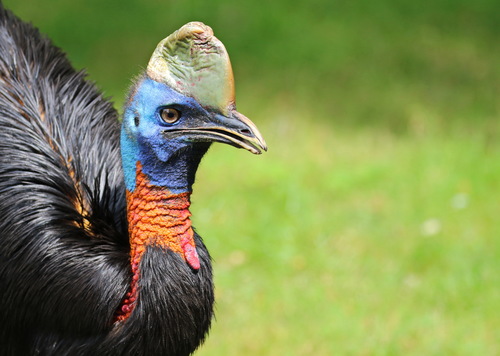
Northern Cassowary
Casuarius unappendiculatus
Meet the 'Golden-Necked' giant of the New Guinea jungle, a living link to the age of dinosaurs with a single vibrant wattle and a powerful, silent stride.
Quick Identification
Size
Height: 1.5–1.8 meters (4.9–5.9 feet); Weight: 30–58 kg (66–128 lbs)
Colors
Glossy black body plumage; cobalt blue face and upper neck; vibrant orange or gold lower neck and single wattle; brown horn-like casque.
Key Features
- Single prominent orange or yellow wattle on the throat
- Tall, blade-like casque (helmet) on the head
- Bright blue facial skin with a golden-orange neck
- Massive three-toed feet with a 5-inch dagger-like inner claw
When You’ll See Them
Behavior
The Northern Cassowary is a solitary and elusive giant of the rainforest floor. Despite their intimidating size and prehistoric appearance, they are generally shy and prefer to slip silently through dense undergrowth when they sense humans approaching. They are quintessential "keystone species," playing a vital role in the ecosystem by consuming large fruits and dispersing seeds that other animals cannot handle. Unlike many bird species, the female is the larger and more dominant sex, often maintaining a territory that encompasses those of several males.
Social interactions are rare outside of the breeding season. When a female accepts a mate, she will lay a clutch of large, green eggs and then leave, leaving the male to perform all incubation and chick-rearing duties for the next nine months. While they are peaceful foragers, they are notoriously defensive of their young and can deliver powerful, potentially lethal kicks if they feel cornered or threatened.
EverydayEarth exclusive
Camera Tips
Capturing a Northern Cassowary on camera requires a strategy focused on height and stability. Because these birds can stand nearly six feet tall, a standard ground-level trail camera placement will likely only capture their thick, scaly legs. For the best results, mount your camera at chest height (approximately 3 to 4 feet) and angle it slightly upward. This ensures you capture the vibrant colors of the neck, the unique shape of the casque, and the single golden wattle that distinguishes this species from its cousins.
Location is everything when tracking these birds. Look for "cassowary highways"—well-worn paths through the ferns—or areas with a high concentration of fallen fruit, particularly wild figs or plums. If you find a pile of large, seed-filled droppings, you are in a prime spot; these birds often revisit the same foraging patches daily. Avoid placing cameras too close to the fruit itself, as the bird's massive body may trigger the sensor too late, resulting in a blurry photo of a tail. Instead, aim the camera at a clear approach path 10-15 feet away.
Because Northern Cassowaries are dark-feathered and live in the high-contrast shadows of the rainforest canopy, use a camera with a high-quality PIR (passive infrared) sensor and a fast trigger speed (0.3 seconds or less). They move with a rhythmic, bobbing gait that can easily cause motion blur in low light. Setting your camera to record 15-20 second video clips is often more rewarding than stills, as it allows you to see their cautious movements and potentially hear their deep, low-frequency "booming" calls that can vibrate through the forest floor.
Finally, durability is key. These are powerful, curious birds. A Northern Cassowary may investigate your camera with its beak or even a cautious kick. Always use a heavy-duty security box and a python cable to secure the unit to a thick tree. Avoid using any shiny or dangling attachments that might pique their curiosity, and ensure the camera is scent-free by handling it with gloves, as their keen sense of smell may lead them to inspect (and potentially damage) the device.
Similar Species
Species that look similar or are commonly confused with Northern Cassowary.
Frequently Asked Questions
Record Northern Cassowary at your habitat
Connect a camera to start building your own species record — AI identifies every visitor automatically.