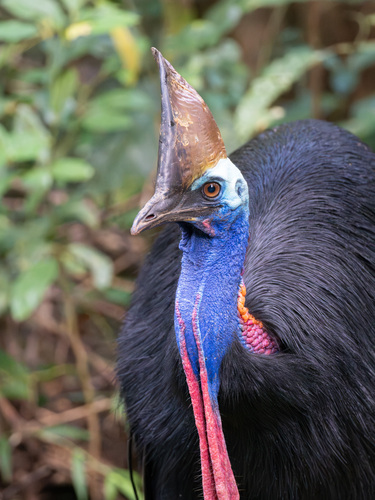
Southern Cassowary
Casuarius casuarius
A prehistoric giant of the Australian tropics, the Southern Cassowary is as majestic as it is elusive. Known for its striking blue neck and towering casque, this flightless wonder is the ultimate 'bucket list' sighting for any backyard naturalist.
Quick Identification
Size
Height: 1.5–1.8 m (4.9–5.9 ft); Weight: 35–75 kg (77–165 lbs)
Colors
Glossy black body feathers; bright blue skin on the head and neck; two vivid red wattles; females are generally more brightly colored than males.
Key Features
- Tall, bony casque (helmet) on top of the head
- Two bright red fleshy wattles hanging from the neck
- Thick, shaggy black plumage that looks like hair
- Massive three-toed feet with a dagger-like inner claw up to 5 inches long
When You’ll See Them
Behavior
The Southern Cassowary is often described as a 'living dinosaur,' and for good reason. These solitary birds are the gardeners of the rainforest; they are a keystone species responsible for dispersing the seeds of over 200 different tropical plant species. Despite their reputation for being territorial, they are generally shy and prefer to avoid human contact, though they can become aggressive if they feel cornered or if they have become accustomed to being fed by people.
Interestingly, the social roles of cassowaries are the reverse of many other bird species. The females are the larger, more dominant sex. After laying a clutch of large, green eggs, the female leaves, and the male takes over all responsibilities. He will incubate the eggs for about two months and then raise the striped chicks for up to nine months, teaching them how to forage and navigate the dense forest floor.
EverydayEarth exclusive
Camera Tips
When setting up an AI-powered camera for a Southern Cassowary, height is your most important variable. Unlike smaller backyard birds, the cassowary is nearly as tall as a human. Mount your camera at a height of about 1.2 to 1.5 meters (4–5 feet) and angle it slightly downward. This ensures you capture the bird's distinctive casque and neck wattles, which are vital for individual identification. Because they are large animals, a wide-angle lens is preferred to prevent the bird from filling the entire frame and causing motion blur.
Strategy is everything when it comes to placement. Look for 'cassowary corridors'—well-worn paths through the undergrowth or clearings near water sources like shallow creeks. If you live in an area where they frequent, placing your camera near native fruiting trees like the Cassowary Plum (Cerbera floribunda) or the Blue Quandong during their fruiting season is a guaranteed way to see them. However, never use artificial bait or food to lure them; this is dangerous for the bird and illegal in many jurisdictions, as it habituates them to human presence.
Check your camera settings for high-speed triggers. While cassowaries often move with a slow, deliberate stride while foraging, they can burst into a run very quickly if startled. A fast shutter speed or high-frame-rate video setting will help you capture a clear image of their powerful legs and shaggy plumage. If your camera has a 'quiet' mode, enable it; despite their size, these birds have excellent hearing and can be spooked by the mechanical clicks of some older camera models.
Finally, protect your gear. Cassowaries are naturally curious and may investigate a new object in their territory with a sharp peck of their beak. Using a sturdy, camouflaged security housing (bear box style) is recommended. Ensure the camera is securely strapped to a thick tree trunk that won't sway in the wind, providing a stable platform for the high-quality video needed for AI species detection.
Similar Species
Species that look similar or are commonly confused with Southern Cassowary.
Emu
The Emu is taller but more slender, lacks the bony casque and vibrant neck colors, and has grayish-brown feathers rather than black.
Dwarf Cassowary
Significantly smaller (up to 1m tall), lacks neck wattles, and is usually found at higher altitudes in New Guinea.
Northern Cassowary
Found in New Guinea; it has only one red or orange wattle on the neck instead of two.
Frequently Asked Questions
Record Southern Cassowary at your habitat
Connect a camera to start building your own species record — AI identifies every visitor automatically.