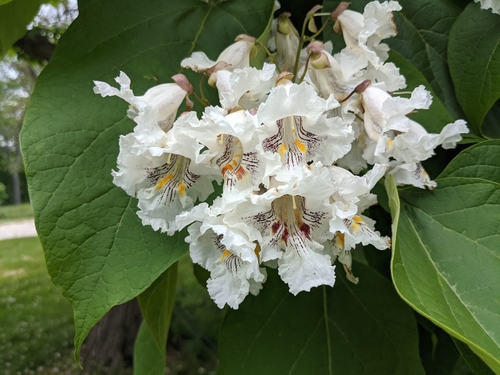
northern catalpa
Catalpa speciosa
A towering giant with heart-shaped leaves and orchid-like blooms, the northern catalpa is a spectacular centerpiece for any backyard ecosystem. Known for its 'cigar' seed pods and its role as a host for the unique Catalpa Sphinx moth, this tree is a skyscraper of life.
Quick Identification
Size
Grows 15–30 meters (50–100 feet) tall with a canopy spread of 6–12 meters (20–40 feet). Trunk diameter can reach 1 meter (3 feet).
Colors
Bright green leaves; showy white flowers with internal purple streaks and yellow spots; dark brown seed pods; grayish-brown furrowed bark.
Key Features
- Extra-large heart-shaped leaves (up to 12 inches long)
- Showy clusters of white orchid-like flowers in late spring
- Long, pendulous, cigar-shaped seed pods
- Coarse, scaly bark on mature specimens
When You’ll See Them
Behavior
The northern catalpa is a fast-growing, charismatic deciduous tree that acts as a central hub for backyard biodiversity. While it appears stationary, it is a hive of activity during its blooming period in late May and June. The tree uses its large, fragrant flowers to attract a wide variety of pollinators, specifically bees and hummingbirds during the day, and various moth species at night. Its massive leaves provide dense shade, making it a preferred nesting site for birds seeking protection from the summer sun.
One of the most fascinating aspects of northern catalpa behavior is its relationship with the Catalpa Sphinx moth. The tree is the sole host for these caterpillars, which can sometimes defoliate portions of the tree. In response, the tree releases volatile chemicals to attract predatory wasps that hunt the caterpillars, showing a sophisticated level of environmental interaction. In winter, the tree retains its long, bean-like seed pods, which rattle in the wind and provide a persistent food source for foraging wildlife when other resources are scarce.
EverydayEarth exclusive
Camera Tips
To capture the true beauty of a northern catalpa on your trail camera, timing is everything. During the late spring bloom (typically late May), mount your camera on a ladder or a nearby structure to reach a height of 8 to 10 feet. Angle the lens downward toward the lower blossom clusters. This positioning allows you to capture the high-speed visits of hummingbirds and bumblebees that are drawn to the nectar-rich flowers. Use a high shutter speed or 'burst mode' to freeze the action of these fast-moving pollinators.
For those interested in the 'micro-wildlife' of the catalpa, position a camera with macro capabilities or a close-focus lens near the trunk or lower branches during mid-summer. This is the best way to document the striking black-and-yellow Catalpa Sphinx caterpillars. If you place your camera facing a section of the trunk with deeply furrowed bark, you may also capture the emergence of the adult moths or the movement of nuthatches and creepers searching the bark crevices for insects.
In the winter months, the northern catalpa's 'cigar' pods become the main attraction. Place your camera on a post or tripod about 5 feet away from a low-hanging branch laden with pods. This is an excellent way to capture squirrels and winter birds like Northern Cardinals or Blue Jays as they attempt to break into the pods. Because the tree is stationary, you can set your camera's trigger sensitivity to 'Medium' to avoid triggers from the wind, but keep the video duration long (15-20 seconds) to observe the animals' foraging techniques.
Finally, don't forget the night shift. The northern catalpa’s flowers are highly fragrant at night to attract hawkmoths. If your camera has a high-quality infrared flash, keep it active during the blooming season. Positioning the camera to look through a cluster of flowers against a dark background can produce ethereal, glowing images of night-visiting insects that many backyard observers never get to see.
Similar Species
Species that look similar or are commonly confused with northern catalpa.
Frequently Asked Questions
Record northern catalpa at your habitat
Connect a camera to start building your own species record — AI identifies every visitor automatically.