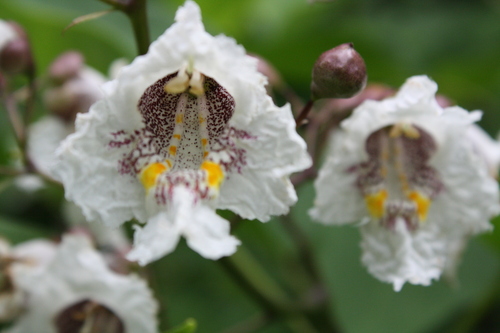
southern catalpa
Catalpa bignonioides
A Southeastern icon known for its massive heart-shaped leaves and showy white blossoms, the Southern Catalpa is a 'living hotel' for pollinators and birds alike. Often called the 'Cigar Tree' for its long seed pods, it offers a year-round spectacle of growth and wildlife activity.
Quick Identification
Size
30-60 feet (9-18 meters) tall with a canopy spread of 20-40 feet (6-12 meters)
Colors
Large bright-green foliage, showy white flowers with yellow and purple interior streaks, and long dark-brown seed pods.
Key Features
- Large heart-shaped leaves up to 12 inches long
- Showy clusters of white, orchid-like flowers in late spring
- Long, pendulous 'cigar' seed pods that persist through winter
- Rough, scaly grey-brown bark on mature trunks
When You’ll See Them
Behavior
The Southern Catalpa is a fast-growing deciduous tree that serves as a central hub for backyard biodiversity. In late spring and early summer, it transforms into a visual masterpiece, covered in large panicles of white flowers that emit a subtle, sweet fragrance. These blooms are highly attractive to pollinators, particularly large bees and hummingbirds during the day, and various sphinx moths at night.
Ecologically, the tree is most famous for its relationship with the Catalpa Sphinx Moth. It is the sole host plant for the moth's larvae, known as 'catalpa worms.' While these caterpillars can occasionally strip the tree of its leaves, the tree is remarkably resilient and usually pushes out a second flush of foliage. This cycle creates a massive food source for insectivorous birds, making the tree one of the best locations in a suburban yard to observe predator-prey interactions.
EverydayEarth exclusive
Camera Tips
To capture the full glory of a Southern Catalpa, set up your camera for a long-term time-lapse. Position the camera on a tripod or fence post approximately 15-20 feet away from the canopy. Starting in early spring, a single photo taken every day at noon will document the dramatic transition from bare branches to massive heart-shaped leaves and the 'snow-covered' effect of the late-spring bloom.
For wildlife enthusiasts, the 'caterpillar phase' in mid-to-late summer is the prime time for action shots. Aim your camera at the lower branches where the leaves are largest. Use a high-sensitivity PIR setting and a short trigger interval, as birds like Cuckoos, Orioles, and Flycatchers will dart in quickly to pluck catalpa worms from the undersides of the leaves. If your camera has a 'near-focus' or macro lens adapter, focus on a specific cluster of leaves to capture the intricate patterns of the sphinx moth larvae.
Don't forget the nocturnal visitors! Because the flowers are designed to attract moths, setting your camera to 'Hybrid Mode' (photo followed by video) with an infrared flash will help you identify the various sphinx moths that hover like hummingbirds in front of the white blossoms after dark. Place the camera 4-6 feet away from a low-hanging flower cluster for the best detail.
In the winter, the Southern Catalpa's long seed pods and furrowed bark become the main attraction. Angle your camera slightly upward along the main trunk to capture nuthatches, brown creepers, and woodpeckers foraging for insects tucked into the bark scales. The 'cigar' pods often stay on the tree through the wind and snow, providing excellent architectural interest for winter backyard photography.
Similar Species
Species that look similar or are commonly confused with southern catalpa.
Frequently Asked Questions
Record southern catalpa at your habitat
Connect a camera to start building your own species record — AI identifies every visitor automatically.