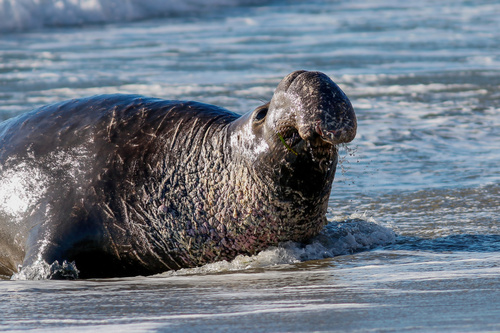
Northern Elephant Seal
Mirounga angustirostris
The Northern Elephant Seal is a true titan of the Pacific, known for its record-breaking deep-sea dives and the thundering roars of the territorial bulls.
Quick Identification
Size
Males: 13-16 ft (4-5 m), weighing up to 5,000 lbs (2,300 kg); Females: 10 ft (3 m), weighing 1,300-1,900 lbs (600-900 kg).
Colors
Tan to rusty brown or grayish; males have a pinkish, calloused chest shield and a large, darker proboscis.
Key Features
- Massive inflatable proboscis (nose) on adult males
- Thick, scarred skin around the neck and chest
- Large, dark eyes specialized for low-light diving
- No external ear flaps and small front flippers
When You’ll See Them
Behavior
Northern Elephant Seals are the ultimate ocean wanderers, spending up to nine months of the year at sea and diving to staggering depths of over 5,000 feet. On land, their behavior shifts dramatically during the winter breeding season. They are highly polygynous, with dominant 'beach master' males defending harems of up to 50 females. These bulls use their trunk-like noses to produce thunderous, rhythmic bellows that can be heard for miles, designed to intimidate rivals without resorting to physical combat.
When they aren't breeding, these seals return to the shore for a 'catastrophic molt.' Unlike most mammals that shed fur gradually, elephant seals lose their entire outer layer of hair and skin in large patches over the course of several weeks. During this time, they are often found huddling together on sandy beaches to conserve body heat, appearing sluggish and lethargic as their bodies focus all energy on regenerating their skin.
EverydayEarth exclusive
Camera Tips
Capturing the scale and power of Northern Elephant Seals requires a strategic approach, especially since they are protected by the Marine Mammal Protection Act. You must maintain a legal distance of at least 50 to 100 feet. To get high-quality close-ups without disturbing the colony, use a trail camera with a high-quality telephoto lens or set up a cellular-enabled camera on a sturdy tripod at a safe, elevated vantage point overlooking the beach. If you have coastal property, placing your camera along the transition zone between the dunes and the sand can capture 'haul-out' behavior as they move inland to rest.
The biggest challenge for coastal cameras is the environment. Salt spray and blowing sand can quickly ruin a lens or sensor. Always use a weather-sealed 'bear box' or protective housing, and consider applying a hydrophobic coating to the lens to prevent water spots. Position your camera facing north or south to avoid the direct glare of the sun reflecting off the ocean and sand, which can lead to overexposed 'white-out' images. Since these animals are massive and move slowly on land, set your PIR sensor to a lower sensitivity to avoid thousands of empty frames, but use a high 'Burst Mode' setting to capture the quick, explosive movements of battling bulls.
Low-angle shots are the secret to professional-looking elephant seal footage. Because they spend their time laying flat on the sand, a camera mounted just 12-24 inches off the ground provides a more intimate, eye-level perspective that emphasizes their size and expression. If you are filming during the breeding season, ensure your camera's microphone is unobstructed; the vocalizations of the males are just as impressive as their appearance and are a vital part of the story. During the morning hours, you can often capture the steam rising from their breath in the cool air, which adds a beautiful atmospheric layer to your captures.
Avoid using any form of bait or lure, as elephant seals do not feed while they are on land. They rely entirely on their blubber stores and will ignore food. Instead, look for 'social hotspots'—areas where females tend to cluster or near natural bottlenecks on the beach where males are likely to patrol. Seasonal timing is critical: if you want to see pups, target late January; for dramatic fights, focus on the early arrival of the bulls in December. Always check your batteries and SD cards before the season begins, as the harsh salt air can accelerate the degradation of electronic components.
Similar Species
Species that look similar or are commonly confused with Northern Elephant Seal.
Frequently Asked Questions
Record Northern Elephant Seal at your habitat
Connect a camera to start building your own species record — AI identifies every visitor automatically.