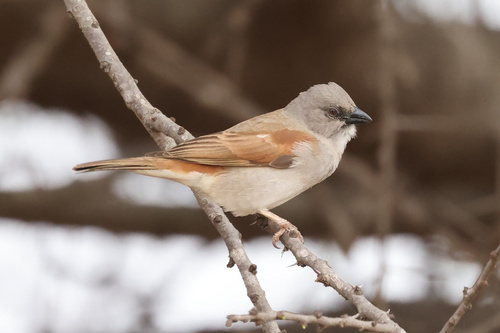
Northern Grey-headed Sparrow
Passer griseus
The friendly and vocal Northern Grey-headed Sparrow is the quintessential garden companion across tropical Africa. With its sleek grey hood and warm chestnut back, this adaptable bird brings a lively social energy to any backyard feeder.
Quick Identification
Size
Length: 14–15 cm (5.5–6 in); Weight: 18–30 g (0.6–1.1 oz)
Colors
Slate-grey head and neck, warm chestnut-brown mantle and wings, pale greyish-white underparts; sexes appear identical.
Key Features
- Uniform slate-grey head without a black bib
- Rich chestnut or rufous back and wing coverts
- Strong, thick black conical bill
- Small white patch on the wing shoulder
When You’ll See Them
Behavior
The Northern Grey-headed Sparrow is a bold and gregarious bird that has successfully integrated itself into human environments across tropical Africa. Much like the House Sparrow in the Northern Hemisphere, this species is a frequent visitor to gardens, farms, and urban centers. They are highly social, often seen in pairs or small family groups, and are known for their constant, cheerful vocalizations consisting of various chirps and metallic 'cheep' sounds.
These sparrows are remarkably adaptable and show little fear of humans, often scavenging for crumbs in outdoor cafes or nesting in the eaves of houses. They are also known for their love of dust-bathing, a social activity where several birds will gather to flick dry soil over their feathers to maintain plumage health. Despite their friendly appearance, they can be quite feisty when defending their nesting sites or preferred feeding spots from other small birds.
EverydayEarth exclusive
Camera Tips
To get high-quality footage of Northern Grey-headed Sparrows, focus your camera on ground-level activity. These birds are natural foragers and spend a significant amount of time hopping across lawns or patios looking for seeds. Setting your camera on a low tripod or mounting it 1–2 feet above a flat feeding tray will provide the best 'eye-level' perspective. Because they are small and move quickly, use a fast shutter speed or a high-frame-rate video setting to avoid motion blur during their energetic hops.
Luring them to your camera is straightforward: a mix of birdseed, millet, or even crushed maize will draw them in quickly. If you want to capture unique behaviors like social bathing, place a shallow birdbath (no more than 2 inches deep) in a sunny spot near some cover. Sparrows feel safest when they have a nearby bush or hedge to retreat to if a predator appears. Position your camera to face away from the sun—preferably facing North or South—to avoid blowing out the soft grey tones of their plumage in the harsh African light.
Since these birds are year-round residents, you can capture their entire life cycle. During the breeding season (which often follows the rains), look for them carrying nesting materials like dry grass and feathers. If your camera has a 'time-lapse' feature, try pointing it toward a hole in a building's eaves or a thick tree cavity where they might be nesting. This can provide a fascinating look at the frequency of their feeding trips once the chicks have hatched.
Similar Species
Species that look similar or are commonly confused with Northern Grey-headed Sparrow.
Southern Grey-headed Sparrow
Very similar but has a slightly paler grey head and prefers drier, more southern regions of Africa.
House Sparrow
Males have a prominent black bib and chestnut markings on the head, whereas the Grey-headed is more uniform.
Swainson's Sparrow
Larger and darker with a heavier bill, typically found in the highlands of Ethiopia and surrounding areas.
Frequently Asked Questions
Record Northern Grey-headed Sparrow at your habitat
Connect a camera to start building your own species record — AI identifies every visitor automatically.