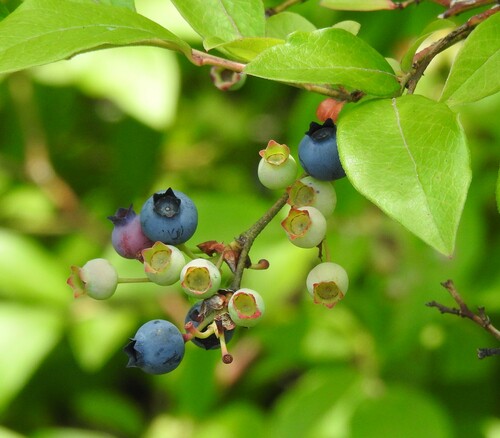
Northern highbush blueberry
Vaccinium corymbosum
A champion of the backyard landscape, the Northern highbush blueberry offers a year-round spectacle of delicate blooms, delicious fruit, and fiery autumn color. It is a vital resource for pollinators and birds alike, serving as a buzzing hub of activity from spring through fall.
Quick Identification
Size
Height: 6–12 feet (1.8–3.7 m); Spread: 8–12 feet (2.4–3.7 m)
Colors
Green leaves turning vibrant red/orange in fall; white to pink bell-shaped flowers; dusky blue berries with a waxy coating
Key Features
- Urn-shaped white or pink flowers in spring
- Dusky blue berries with a star-shaped crown
- Vibrant scarlet autumn foliage
- Peeling, grayish-brown bark on older stems
When You’ll See Them
Behavior
The Northern highbush blueberry is a foundational species in North American ecosystems, acting as a centerpiece for backyard biodiversity. While it remains stationary, its 'behavior' is defined by a rhythmic seasonal cycle that dictates the movements of dozens of other species. In early spring, it produces clusters of nectar-rich blossoms that are a primary food source for emerging queen bumblebees. As the season progresses, it focuses its energy on developing nutrient-dense fruit that changes from green to pink to deep indigo.
Unlike many other shrubs, the Northern highbush blueberry is long-lived and provides structural stability to the garden. It interacts with its environment by acidifying the soil through its leaf litter and providing dense, twiggy cover for ground-nesting birds. During the summer months, it becomes a hub of high-energy interaction as birds, mammals, and insects compete for its ripening fruit, making it one of the most socially 'active' plants in a backyard setting.
EverydayEarth exclusive
Camera Tips
To capture the high-traffic wildlife that Northern highbush blueberry attracts, your camera placement is everything. Mount your camera on a stake or tripod roughly 3 to 4 feet off the ground, angled slightly downward toward the heaviest cluster of ripening berries. This height is the 'sweet spot' for capturing the arrival of songbirds like Gray Catbirds, Cedar Waxwings, and Eastern Bluebirds. If you are using an AI-powered camera, ensure the lens is clean of any pollen or dust, as the fine details of the berries and the birds' plumage are the highlights of these shots.
Lighting can be a challenge with plants. Position your camera facing North or South to avoid the 'sun flare' that occurs when the sun is directly behind the plant, which can wash out the deep blue hues of the fruit. For the best color saturation, the early morning hours (6-9 AM) provide a soft, golden light that makes the waxy 'bloom' on the blueberries pop against the green foliage. If your camera has a 'Macro' or 'Close-up' focus mode, use it to document the intricate bell-shape of the spring flowers, which are often swarming with native bees.
Don't stop filming when the sun goes down! Many nocturnal foragers, including Flying Squirrels, Opossums, and Raccoons, visit the Northern highbush blueberry under the cover of darkness. Use your camera's Infrared (IR) setting and set it to record short 10-15 second video clips. This allows you to see the specific feeding behaviors of these animals. During the peak of the berry season, set your trigger sensitivity to medium-high; while the wind might cause occasional false triggers by swaying the branches, you don't want to miss the split-second landing of a small bird or the cautious approach of a mammal.
Finally, consider a long-term strategy. The Northern highbush blueberry is one of the best subjects for a seasonal time-lapse. By taking a single photo from the same angle once a day throughout the year, you can document the incredible transformation from the 'nude' winter branches to the white spring blossoms, the blue summer fruit, and finally the fiery red autumn leaves. Ensure your camera is securely mounted to a permanent post for this to keep the frame consistent over the months.
Similar Species
Species that look similar or are commonly confused with Northern highbush blueberry.
Lowbush Blueberry
Much shorter (under 2 feet) and spreads via underground runners rather than forming a tall, upright shrub.
Black Huckleberry
Has tiny yellow resin dots on the underside of leaves and seeds that are noticeably crunchier when eaten.
Deerberry
Flowers have much longer stamens that extend far beyond the floral tube, and the berries are often greenish or white.
Frequently Asked Questions
Record Northern highbush blueberry at your habitat
Connect a camera to start building your own species record — AI identifies every visitor automatically.