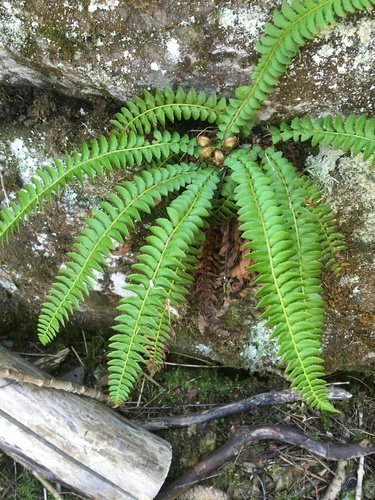
northern holly fern
Polystichum lonchitis
A hardy survivor of the high peaks and rocky ravines, the northern holly fern is famous for its leathery, evergreen fronds that defy the winter snow. Its distinctive 'mitten-shaped' leaves make it an iconic find for any backyard explorer in northern climates.
Quick Identification
Size
Fronds typically grow between 15 and 60 cm (6 to 24 inches) long, forming a tight, upright clump.
Colors
Deep glossy green fronds with rusty-brown or tan scales at the base of the stem (stipe).
Key Features
- Stiff, leathery once-pinnate fronds
- Individual leaflets (pinnae) shaped like a 'mitten' or 'sock' with a pointy thumb
- Sharply serrated or spiny leaf edges
- Evergreen foliage that stays green through the winter
When You’ll See Them
Geographic range
Where Does the northern holly fern Live?
The northern holly fern is a circumpolar species native to the cooler reaches of the Northern Hemisphere. It is widely distributed across northern Europe, Russia, and Japan, extending through Canada and into the mountainous regions of the United States. In North America, its core range includes the Pacific Northwest, the Rocky Mountains, and the Great Lakes region, where it clings to rocky outcroppings and cool, shaded ravines.
Basemap © OpenStreetMap contributors
Behavior
The northern holly fern is a rugged and resilient perennial that behaves quite differently from the delicate, feathery ferns many people envision. It is a slow-growing species that establishes itself in stable, rocky environments. Unlike deciduous ferns that wither at the first frost, this species is truly evergreen; its stiff, leathery fronds are designed to withstand heavy snow loads, often pressing flat against the ground in winter and springing back up as the snow melts.
In the wild, it doesn't 'move' in the traditional sense, but it does follow a seasonal rhythm of spore production. In late summer, the undersides of the leaves become dotted with small, circular structures called sori, which release dust-like spores into the wind. It is a non-aggressive plant, often growing in solitary clumps or small clusters where it provides essential micro-shelter for ground-dwelling insects and small amphibians like salamanders.
EverydayEarth exclusive
Camera Tips
Capturing the northern holly fern on camera requires a different approach than moving wildlife. Because it is stationary, your goal is to showcase its architectural form and the life that interacts with it. Use a macro lens or a camera with a high-quality 'macro' mode to capture the intricate, spiny margins of the leaves and the fascinating spore-bearing sori on the undersides. A low-angle shot, looking slightly upward at the fern, emphasizes its 'holly-like' stiffness and structural beauty.
For trail camera users, this fern is an excellent 'background' marker for a setup. Place your camera near a northern holly fern clump in a rocky crevice, as these areas are often corridors for small mammals like pikas or chipmunks. Because the fern is evergreen, it provides a consistent visual frame for your shots throughout the seasons. If you are using an AI-powered camera, ensure the sensitivity is adjusted so that the occasional swaying of the fronds in high winds doesn't trigger thousands of 'false positive' clips.
One of the most rewarding ways to document this species is through time-lapse photography. Set your camera to take one photo every few hours during the spring (late April to June). You will capture the dramatic 'unfirling' of the fiddleheads—the young, coiled fronds—as they emerge from the center of the crown and slowly expand into their stiff, adult forms. This process is surprisingly dynamic when viewed in a high-speed playback.
Similar Species
Species that look similar or are commonly confused with northern holly fern.
Frequently Asked Questions
Record northern holly fern at your habitat
Connect a camera to start building your own species record — AI identifies every visitor automatically.