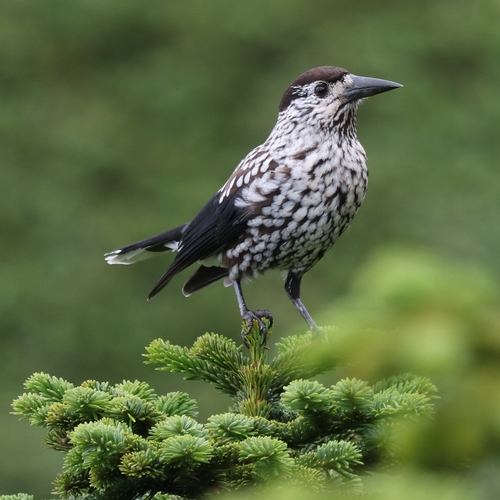
Northern Nutcracker
Nucifraga caryocatactes
The brilliant memory-master of the mountains, the Northern Nutcracker is a chocolate-brown marvel that can remember thousands of secret seed locations across the forest.
Quick Identification
Size
Length 32-38 cm (12.5-15 in); Wingspan 52-59 cm (20.5-23 in); Weight 125-200 g (4.4-7.1 oz)
Colors
Deep chocolate brown body with dense white teardrop-shaped spots; black cap, wings, and tail; white undertail coverts.
Key Features
- Large, dagger-like black bill
- Chocolate brown plumage with heavy white spotting
- Broad, rounded wings with a greenish-black gloss
- Short tail with prominent white outer feathers
When You’ll See Them
Geographic range
Where Does the Northern Nutcracker Live?
The Northern Nutcracker is native to a vast belt of the Northern Hemisphere, stretching from Scandinavia and the European Alps across the sprawling Siberian taiga to the Russian Far East, China, and Japan. It thrives in high-altitude mountain ranges and the northern boreal forests where its preferred seed-bearing trees are abundant. While usually sedentary, these birds are known for dramatic 'irruptions,' where thousands may migrate into Western Europe when seed crops fail in their native Eastern range.
Basemap © OpenStreetMap contributors
Behavior
The Northern Nutcracker is a master of spatial memory and one of the most intelligent birds in the coniferous forest. It is famous for its specialized relationship with stone pines and hazel trees, gathering thousands of seeds during the autumn and caching them in the ground as winter stores. Remarkably, a single bird can remember the locations of up to 30,000 individual seeds, even when the landscape is covered in several feet of snow.
While they can be vocal and bold—frequently announcing their presence with a loud, rasping 'kraak-kraak-kraak'—they are also incredibly focused foragers. Unlike many other members of the crow family, they are less social and usually found in pairs or small family groups. Their flight is distinctive, featuring heavy, undulating movements that highlight their broad wings and white tail markings.
EverydayEarth exclusive
Camera Tips
To capture the Northern Nutcracker on your trail camera, focus on their caching and foraging habits. These birds are most active on the ground or low stumps during late summer and autumn (August to October) when they are busy storing nuts. Position your camera about 3 to 5 feet off the ground, aiming at an old mossy log or a flat-topped stone. These 'natural tables' are preferred spots for nutcrackers to land and process seeds.
If you want to attract them specifically to a backyard camera, offer whole, unshelled hazelnuts or walnuts. These high-energy treats are irresistible to corvids. Place the nuts in a way that requires the bird to land and spend a few seconds picking them up, giving your AI camera time to trigger. Because they have a rapid, jerky movement when handling food, set your camera to a fast shutter speed and use 'Burst Mode' to capture the perfect frame of their white-spotted plumage.
Placement in coniferous areas is key. If you have a stone pine or hazel tree on your property, aim the camera at the base of the trunk or a nearby clearing where they might hide their stores. Nutcrackers are quite bold but wary of sudden movements; ensure your camera is well-camouflaged with local pine needles or bark to avoid spooking them during their rhythmic caching routines.
Similar Species
Species that look similar or are commonly confused with Northern Nutcracker.
Frequently Asked Questions
Record Northern Nutcracker at your habitat
Connect a camera to start building your own species record — AI identifies every visitor automatically.