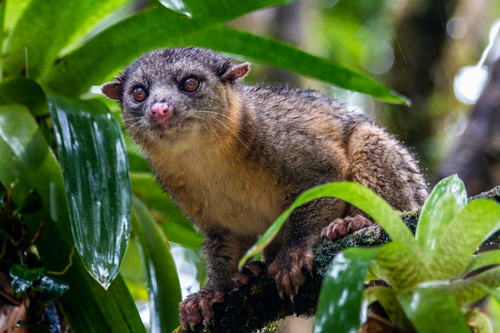
Northern Olingo
Bassaricyon gabbii
Meet the ghost of the canopy—the Northern Olingo is a rare, agile relative of the raccoon that spends its life in the treetops. Discover how to spot this elusive nocturnal acrobat using your backyard trail camera.
Quick Identification
Size
Body length 36–48 cm (14–19 in); tail length 37–48 cm (15–19 in); weight 1.1–1.5 kg (2.4–3.3 lbs).
Colors
Grayish-brown to yellowish-tan fur with a pale cream underbelly; faint dark rings are often visible on the long, bushy tail.
Key Features
- Long, bushy, non-prehensile tail with faint dark rings
- Pointed snout with a pinkish nose and large, rounded ears
- Large, forward-facing eyes adapted for night vision
- Slender, squirrel-like body built for high-altitude climbing
When You’ll See Them
Behavior
The Northern Olingo is a master of the tropical canopy, spending nearly its entire life high above the forest floor. Despite being a member of the raccoon family, these agile mammals move through the trees with the grace of a squirrel, often leaping significant distances between branches to reach their favorite fruit. They are primarily solitary creatures, though they are occasionally spotted in pairs or small, loose groups when a particularly abundant fruit tree, like a wild fig, is in peak production.
Unlike their more famous relative, the Kinkajou, Olingos do not have prehensile tails; they use their bushy tails strictly for balance as they sprint across narrow limbs. They are generally shy and will retreat into dense foliage if they sense a predator or human presence. They are known to produce high-pitched, bird-like chirps and whistles to communicate with other olingos in the darkness, a sound that often gives away their presence before they are actually seen.
EverydayEarth exclusive
Camera Tips
Capturing a Northern Olingo on camera requires thinking vertically. Since these animals are strictly arboreal and rarely touch the ground, traditional trail camera placement on a tree trunk at eye level will likely only catch a blur as they climb past. For the best results, mount your AI-powered camera high in the canopy or on a sturdy, horizontal branch that serves as a natural 'bridge' between trees. Look for fruit-bearing trees currently in season—wild figs, guavas, or mangoes are magnetic for this species.
Because they are strictly nocturnal, your camera's infrared (IR) flash and sensor sensitivity are paramount. Set your camera to 'High Sensitivity' and use 'Video Mode' or 'Burst Mode' to capture their rapid movements. To get a high-quality 'hero' shot, position the camera at a 45-degree angle to the branch rather than perpendicular. This allows the AI more time to detect the animal as it approaches, ensuring you get the face and the full length of the body in the frame.
If you want to encourage a visit to a specific spot, you can create a temporary arboreal 'feeding station' by securing a platform or a basket of overripe bananas and honey to a branch about 15 feet off the ground. Ensure the camera is positioned 5-8 feet away from the bait to maintain focus. During the dry season, Olingos are more likely to visit predictable water sources or specific fruiting trees, making this the best time to monitor your footage daily.
Similar Species
Species that look similar or are commonly confused with Northern Olingo.
Kinkajou
Larger with a prehensile tail and a much rounder face; lacks the olingo's bushy tail appearance.
Olinguito
Smaller with much thicker, fluffier fur and a shorter tail; typically found only in high-elevation cloud forests.
Cacomistle
Features a much more distinct, bold black-and-white ringed tail and a more slender, cat-like body.
Frequently Asked Questions
Record Northern Olingo at your habitat
Connect a camera to start building your own species record — AI identifies every visitor automatically.