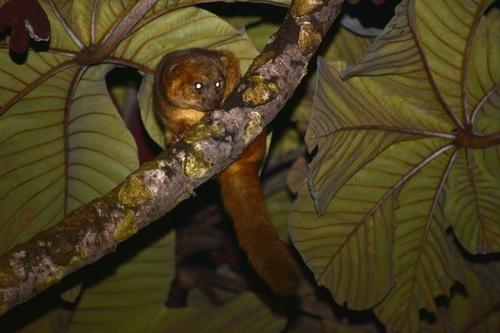
Olinguito
Bassaricyon neblina
Meet the 'mist-walker' of the Andes, a teddy-bear-faced mammal that remained hidden from science until 2013. This elusive, woolly resident of the cloud forest is the smallest member of the raccoon family.
Quick Identification
Size
Body length of 13-16 inches (32-40 cm), tail length of 13-17 inches (33-43 cm); weight between 1.7-2.4 lbs (0.75-1.1 kg).
Colors
Dense, woolly reddish-brown or orange-brown fur with dark tips; underbelly is a lighter cream or yellowish color.
Key Features
- Thick, woolly fur adapted for cold mist
- Long, bushy non-prehensile tail
- Large, forward-facing brown eyes
- Small, rounded ears nearly hidden in fur
- Short, blunt muzzle
When You’ll See Them
Behavior
The Olinguito is a master of the Andean canopy, spending almost its entire life high above the forest floor. These agile mammals are expert leapers, capable of jumping from branch to branch through the dense, mossy vegetation of the cloud forest. While they are members of the order Carnivora, they are primarily solitary and spend their nights quietly searching for fruit in the mist.
Because they live in high-altitude environments where temperatures drop significantly at night, their thick, woolly fur is an essential adaptation for thermoregulation. They are generally shy and avoid human interaction, though they have been known to visit fruit feeders at eco-lodges within their range. Mothers are devoted parents, typically raising a single kit at a time, hidden away in tree hollows.
EverydayEarth exclusive
Camera Tips
To capture an Olinguito on a trail camera, you must move your perspective off the ground. These animals are strictly arboreal, meaning ground-level sets will almost never find them. Look for 'canopy highways'—thick, horizontal branches covered in moss and epiphytes that connect different fruit-bearing trees. Mounting your camera 10 to 20 feet up a trunk, angled toward one of these crossing points, is the most effective strategy.
Attractants are highly recommended for this species. A small platform or mesh bag containing overripe bananas, figs, or even a smear of honey can entice an Olinguito to linger in front of the lens. Since they are nocturnal and live in high-humidity 'mist forests,' lens fogging is your biggest enemy. We recommend using a camera with a high-quality glass lens and applying a rain-repellent or anti-fog coating to the external housing to ensure your images remain crisp in the damp mountain air.
Settings-wise, prioritize a fast trigger speed (0.3 seconds or less) because Olinguitos move with surprising agility. Use a 'No-Glow' or Black LED infrared flash to avoid startling the animal, which might cause it to abandon the feeding site. Setting your camera to record 15-20 second video clips is often more rewarding than still photos, as it allows you to observe their unique climbing mechanics and vocalizations, which include soft chirps and whistles.
Similar Species
Species that look similar or are commonly confused with Olinguito.
Frequently Asked Questions
Record Olinguito at your habitat
Connect a camera to start building your own species record — AI identifies every visitor automatically.