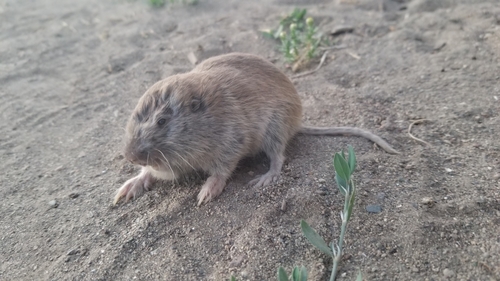
Northern Pocket Gopher
Thomomys talpoides
Meet the master tunneler of the North. The Northern Pocket Gopher is a secretive underground engineer that reshapes the landscape one mound at a time.
Quick Identification
Size
6–9.5 inches (15–24 cm) in length; 2–5.6 ounces (60–160 g) in weight
Colors
Fur ranges from cinnamon-brown to charcoal-gray depending on local soil color; features small white patches under the chin and dark patches behind the ears.
Key Features
- Fur-lined external cheek pouches used for carrying food
- Large, curved front claws specialized for heavy digging
- Small eyes and ears with a short, nearly hairless tail
- Large yellowish incisors that remain visible even when the mouth is closed
When You’ll See Them
Behavior
Northern Pocket Gophers are the ultimate underground architects of the West. These solitary rodents spend up to 90% of their lives in extensive tunnel systems that can span hundreds of feet in length. You’ll rarely see them roaming on the surface; instead, you’ll see the evidence of their work: characteristic fan-shaped mounds of loose soil. Unlike moles, which create conical, volcano-like mounds, gophers push dirt out of a side tunnel at an angle, leaving a visible 'plug' on one side of the mound.
They are notoriously antisocial and territorial creatures. Except during the spring mating season, a single gopher will fiercely defend its tunnel system from any intruders, including members of its own species. While they may be frustrating for gardeners, their constant digging serves a vital ecological purpose by aerating the soil, increasing water infiltration, and bringing deep, nutrient-rich earth to the surface.
EverydayEarth exclusive
Camera Tips
Capturing a Northern Pocket Gopher on camera requires a bit of 'underground' strategy. Since they rarely leave their tunnels, your best bet is to find a fresh mound—look for dark, moist soil that hasn't dried out yet. Using a small trowel, gently clear the 'plug' (the small circle of dirt sealing the tunnel) to open the hole. The gopher will sense the change in temperature and light and will eventually come to the surface to repair the breach and re-seal the tunnel.
Position your camera on a low tripod or directly on the ground about 2–3 feet away from the opened hole. Angle the lens slightly downward to capture the gopher's face as it emerges. Because these animals are highly sensitive to vibrations, use a camera with a silent shutter or a PIR sensor with a very fast trigger speed (0.2s or less) to catch the split-second they appear at the entrance. If your camera has a 'Macro' or close-focus mode, be sure to enable it.
Timing is everything. Early morning or late evening is when they are most likely to perform 'housekeeping.' While they aren't easily baited like squirrels, placing a few pieces of fresh carrot or a dandelion root just inside the opened tunnel entrance can encourage them to linger long enough for a clear shot. Ensure your camera is set to video mode or a high-speed photo burst, as their appearance is often brief—they push a load of dirt out and disappear back into the dark within seconds.
Similar Species
Species that look similar or are commonly confused with Northern Pocket Gopher.
Frequently Asked Questions
Record Northern Pocket Gopher at your habitat
Connect a camera to start building your own species record — AI identifies every visitor automatically.