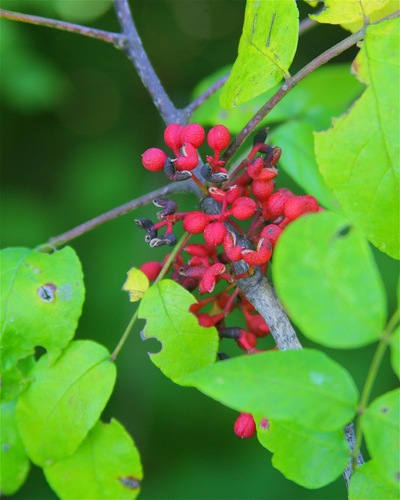
northern prickly ash
Zanthoxylum americanum
Often called the 'Toothache Tree' for its numbing properties, this aromatic citrus relative is the secret to attracting North America's largest butterflies to your backyard. Its thorny branches provide a safe haven for birds while its lemon-scented leaves feed the next generation of pollinators.
Quick Identification
Size
A multi-stemmed shrub or small tree growing 4-10 meters (13-33 ft) tall with a trunk diameter of up to 15 cm (6 in).
Colors
Dark green compound leaves, gray-brown bark with silver mottling, yellowish-green flowers, and small red to brownish seed pods.
Key Features
- Sharp, paired prickles at the base of each leaf
- Pinnately compound leaves with 5-11 leaflets
- Crushed leaves and fruit have a distinct lemon-citrus scent
- Small, fleshy red follicles that open to reveal shiny black seeds
When You’ll See Them
Geographic range
Where Does the northern prickly ash Live?
Northern prickly ash is native to the central and eastern regions of North America. Its range extends from Quebec and Ontario in Canada southward through the United States to Georgia and as far west as the Dakotas and eastern Oklahoma. It is most commonly found in the Midwest and Northeast, where it flourishes in the transition zones between forests and open fields.
Basemap © OpenStreetMap contributors
Behavior
Northern prickly ash is a hardy, thicket-forming shrub that acts as a vital nursery for local biodiversity. Unlike many garden plants, it is chemically unique; as the northernmost member of the citrus family in North America, its tissues contain alkaloids that produce a numbing sensation when chewed, earning it the nickname "Toothache Tree." It grows aggressively via underground rhizomes, often forming dense, protective colonies that provide excellent cover for small wildlife.
While it may seem stationary, this species is a hub of activity. It is the primary host plant for the Giant Swallowtail butterfly, the largest butterfly in North America. Throughout the growing season, the shrub manages a complex relationship with herbivores—defending itself with sharp thorns while providing essential nutrients to specific caterpillar species that have evolved to bypass its chemical defenses. In the fall, its aromatic berries become a high-energy food source for various bird species.
EverydayEarth exclusive
Camera Tips
To capture the dynamic life surrounding your Northern prickly ash, position your camera at a mid-level height, approximately 3 to 4 feet off the ground, focusing on a cluster of leaves or the red berries. Since this plant is the primary host for the Giant Swallowtail butterfly, using a camera with a high-speed trigger or a macro lens capability will help you document the life cycle from "bird-dropping" mimics (caterpillars) to the stunning yellow and black adults. Ensure the lens is angled to catch the afternoon sun, which often highlights the translucence of the leaflets and the vibrant color of the ripening fruit.
For the best results, use a "time-lapse" mode if your AI camera supports it. This allows you to watch the shrub's rapid spring growth or the transition of the berries from green to a deep, rusty red. If you are targeting birds like catbirds or cedar waxwings that love the seeds, place the camera on a nearby branch or a dedicated tripod about 5 feet away to avoid spooking them, ensuring the "motion zone" is tightly focused on the berry clusters to avoid false triggers from wind-blown branches.
Adjust your camera's sensitivity settings during the peak of summer. The Northern prickly ash has delicate, compound leaves that move easily in the breeze, which can drain batteries on standard motion-sensing cameras. By using AI-filtering for "Insects" or "Birds," you can bypass the movement of the thorns and foliage to only record the visitors. Don't forget to check your camera during the late evening; the aromatic oils of the plant are particularly pungent at dusk, often attracting unique nocturnal pollinators or moths that may not visit during the heat of the day.
In winter, the plant's sharp prickles and architectural form make for excellent "perch" photography. With a light dusting of snow, the gray bark and dark thorns provide a high-contrast backdrop for wintering birds. Keep your camera active year-round, as the structural complexity of a prickly ash thicket provides vital cover for small mammals and ground-nesting birds, which your camera can capture scurrying beneath the protective, thorny canopy.
Similar Species
Species that look similar or are commonly confused with northern prickly ash.
Hercules' Club
Much larger thorns that cover the entire trunk, whereas northern prickly ash only has prickles at the leaf bases and on branches.
Common Ash
Lacks thorns entirely and has much larger, non-aromatic leaflets compared to the small, citrus-scented leaves of the prickly ash.
Wafer Ash
Also in the citrus family, but has leaves divided into 3 leaflets (trifoliate) rather than the 5-11 leaflets found on northern prickly ash.
Frequently Asked Questions
Record northern prickly ash at your habitat
Connect a camera to start building your own species record — AI identifies every visitor automatically.