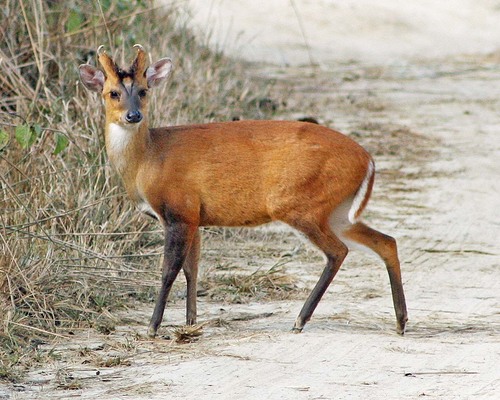
Northern Red Muntjac
Muntiacus vaginalis
Often heard before they are seen, the Northern Red Muntjac is a primitive and fascinating 'barking deer' that brings a touch of the wild to forest edges and rural gardens.
Quick Identification
Size
Body length 90–120 cm (35–47 in); Shoulder height 45–55 cm (18–22 in); Weight 15–35 kg (33–77 lb)
Colors
Rich reddish-brown or chestnut coat; creamy-white underparts; dark brown facial markings; males have dark hair-covered pedicels
Key Features
- Short, unbranched antlers on long, fur-covered pedicels (males)
- Visible upper canine teeth that look like small tusks
- Deep facial scent glands below the eyes
- Stocky, rounded body with slender legs
When You’ll See Them
Behavior
The Northern Red Muntjac is widely known as the 'barking deer' because of its deep, resonant alarm call that sounds remarkably like a dog. This vocalization is used when the deer senses a predator or during territorial disputes, sometimes continuing for over an hour. They are primarily solitary and highly territorial animals, using their prominent preorbital scent glands to mark bushes and trees within their home range.
Despite their somewhat delicate appearance, they are resilient and can be quite aggressive when defending their space. Males use their small antlers for shoving and their sharp canine tusks for slashing at rivals. While they are naturally shy and prefer to stay near the safety of dense cover, they have adapted well to human-modified landscapes, often venturing into gardens or orchards that border forested areas.
EverydayEarth exclusive
Camera Tips
To capture the best footage of the Northern Red Muntjac, camera height is critical. Because these deer are much smaller than most people realize, mounting your camera too high will result in a top-down view that misses their unique facial features. Aim for a mounting height of 18 to 24 inches above the ground. Angle the camera slightly upward if the trail is on an incline to ensure you catch the 'tusks' of the males and the deep V-shaped markings on their foreheads.
Muntjacs are creatures of habit and frequently use the same 'runways' through thick vegetation. Look for small, hoof-printed paths that lead from dense brush toward water sources or clearings. Positioning your camera at the junction where a forest edge meets a garden is a high-probability spot. They are particularly attracted to fallen fruit, so if you have a fruiting tree like a fig, wild mango, or even a fallen bird feeder, point your camera there to catch them foraging.
Because they are most active during the 'golden hours' of dawn and dusk, a camera with a high-quality low-light sensor is a must. Use a 'No-Glow' or 'Black' infrared flash to avoid spooking them, as they are extremely alert to artificial lights and may bark and flee if they detect a bright flash. Set your trigger speed to the fastest possible setting (0.3 seconds or less) because they tend to move with a nervous, jerky gait and rarely stand still for long.
We highly recommend using 'Video Mode' with audio enabled. The visual of a muntjac is fascinating, but the sound of its bark is one of the most iconic experiences in backyard wildlife observation. Hearing the alarm call on your recording provides a much richer context of what else might be in the area, such as a wandering neighborhood dog or a predator, which likely triggered the deer's vocalization.
Similar Species
Species that look similar or are commonly confused with Northern Red Muntjac.
Frequently Asked Questions
Record Northern Red Muntjac at your habitat
Connect a camera to start building your own species record — AI identifies every visitor automatically.