Northern Redbelly Dace
Chrosomus eos
A miniature jewel of northern wetlands, the Northern Redbelly Dace is famous for the male's stunning transition into fiery crimson during the spring breeding season.
Quick Identification
Size
1 to 3 inches (2.5 to 7.6 cm) in length; weight is negligible, usually just a few grams.
Colors
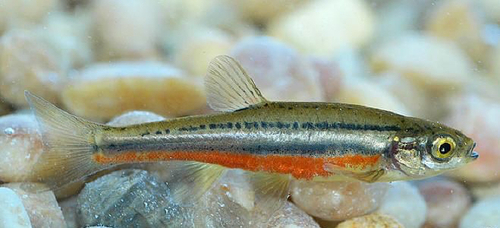
Olive to brownish-green back with two distinct dark lateral stripes. Breeding males develop a brilliant crimson or bright red belly and yellow fins.
Key Features
- Two parallel dark horizontal stripes on each side
- Brilliant red belly in breeding males
- Small, upturned mouth
- Fine scales that give the skin a smooth, velvety texture
When You’ll See Them
Geographic range
Where Does the Northern Redbelly Dace Live?
The Northern Redbelly Dace is a native of the North American continent, flourishing across a broad northern latitudinal band. Its core population resides in the boreal regions of Canada, stretching from the maritime provinces of the east all the way to the Rocky Mountain foothills in the west. In the United States, they are commonly found throughout the Great Lakes region, New England, and into the northern Great Plains, with isolated populations reaching as far south as Colorado and Nebraska where cool, spring-fed waters persist.
Basemap © OpenStreetMap contributors
Behavior
The Northern Redbelly Dace is a social, schooling fish that spends its day darting through the shallows of quiet waters. They are highly active during daylight hours, navigating through dense aquatic vegetation to avoid larger predators like bass or pike. While they are small, their schooling behavior provides a level of protection, as the shimmering of dozens of bodies can confuse an attacker.
During the spawning season, which typically occurs from late spring to early summer, their behavior becomes much more animated. Males will vigorously pursue females into patches of filamentous algae, where eggs are deposited. Outside of breeding, they are peaceful residents of their ecosystem, often seen hovering near the bottom or middle of the water column in search of food.
EverydayEarth exclusive
Camera Tips
Capturing the Northern Redbelly Dace requires an underwater approach, as these tiny fish are nearly invisible from the shore. For those with a backyard pond or access to a slow-moving creek, using a waterproof action camera or a specialized underwater 'fish cam' is essential. Place the camera in shallow water (6-12 inches deep) near patches of filamentous algae or submerged logs, as these are the areas where the dace naturally congregate to feed and hide.
To get the best clarity, position the camera facing away from the sun to avoid glare on the water's surface, and ensure the lens is only a few inches away from the vegetation you expect them to visit. Since these fish are small, a wide-angle lens is helpful, but you’ll want to get as close as possible to see the intricate details of their stripes. Setting your camera to a higher frame rate (60fps or higher) is recommended to capture their quick, darting movements smoothly.
The best time to film is during the late spring spawning run when the males are at their most colorful. To draw them into the frame, you can gently disturb a small patch of the bottom silt or algae to release microscopic food particles, which often triggers a feeding frenzy. Avoid using heavy baits that cloud the water; instead, focus on areas with natural light penetration to highlight the brilliant reds and yellows of the breeding males.
Similar Species
Species that look similar or are commonly confused with Northern Redbelly Dace.
Frequently Asked Questions
Record Northern Redbelly Dace at your habitat
Connect a camera to start building your own species record — AI identifies every visitor automatically.