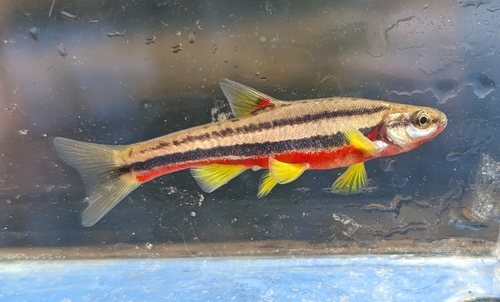
Southern Redbelly Dace
Chrosomus erythrogaster
A hidden gem of North American waterways, the Southern Redbelly Dace is famous for its neon-like stripes and the male’s stunning crimson breeding colors. These social minnows are a delight for any backyard explorer with a clear, cool stream to call their own.
Quick Identification
Size
2 to 3 inches (5 to 8 cm) in length; occasionally reaching 3.5 inches (9 cm)
Colors
Olive to brownish back with two prominent black horizontal stripes; silvery-cream band between stripes; males develop brilliant red bellies and yellow fins during breeding
Key Features
- Two distinct parallel black stripes running horizontally along the side
- Bright red or orange belly on breeding males
- Pointed snout with a small, terminal mouth
- Smooth, very small scales giving a sleek appearance
When You’ll See Them
Geographic range
Where Does the Southern Redbelly Dace Live?
This striking minnow is native to the North American continent, primarily situated within the central and eastern United States. Its core distribution radiates from the Great Lakes region and western New York, stretching westward to Minnesota and South Dakota, and reaching as far south as the northern halves of Oklahoma, Arkansas, and Alabama. While they are widespread across the Mississippi River basin, they are often found in localized, isolated populations where spring-fed headwaters provide the stable, cool temperatures they require to thrive year-round.
Basemap © OpenStreetMap contributors
Behavior
The Southern Redbelly Dace is a social, schooling species that brings vibrant energy to freshwater ecosystems. These fish are remarkably peaceful and spend much of their time darting through clear pools and slow-moving runs in search of food. They are often found in the company of other non-aggressive minnow species, moving in synchronized clusters that help protect them from larger aquatic predators.
During the spawning season, which typically occurs from spring into early summer, their behavior becomes more frantic and visible. Males undergo a dramatic physical transformation, developing intense crimson coloration on their undersides to attract mates. They often congregate over the gravel nests of other fish species, such as Stonerollers, to deposit their eggs in well-oxygenated water. In a backyard stream environment, they are sensitive to water quality and serve as excellent indicators of a healthy, silt-free habitat.
EverydayEarth exclusive
Camera Tips
To successfully capture the Southern Redbelly Dace on camera, you will need an underwater setup or a high-quality glass-bottom observation box. For backyard enthusiasts with a creek, an action camera like a GoPro or a specialized underwater trail camera is essential. Mount the camera on a weighted base or a low-profile tripod and submerge it in 6 to 12 inches of water, targeting the transition zone where a riffle enters a calm pool. This is where dace often congregate to feed on drifting organic matter.
Lighting is the most critical factor for showcasing their brilliant colors. Position your camera so the sun is behind it or directly overhead; this ensures the light penetrates the water column and illuminates the metallic silver and red tones of the fish. Mid-day (11 AM to 2 PM) provides the best natural light. If your stream is heavily shaded by a forest canopy, consider using a waterproof, low-intensity LED fill light to prevent the fish from appearing as mere silhouettes against the gravel.
Since these are small fish, set your camera to a 'Linear' or 'Narrow' field of view to avoid the distortion of wide-angle lenses and make the subject appear larger in the frame. A high frame rate, such as 60 or 120 fps, is highly recommended to capture their quick, darting movements in smooth slow-motion. While you don't need bait, placing a few algae-covered stones directly in front of the lens can encourage the school to linger in the frame. During the spring spawning season, focus your camera on shallow gravel patches where the water is cleanest, as this is where you will witness the most intense color displays and social interactions.
Similar Species
Species that look similar or are commonly confused with Southern Redbelly Dace.
Frequently Asked Questions
Record Southern Redbelly Dace at your habitat
Connect a camera to start building your own species record — AI identifies every visitor automatically.