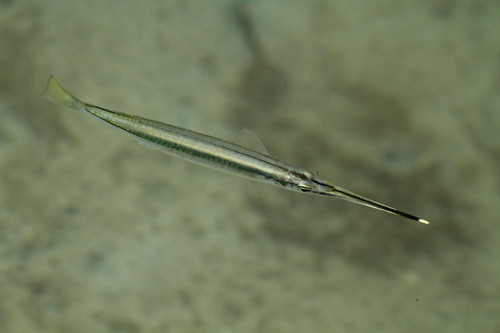
Northern River Garfish
Zenarchopterus buffonis
The Northern River Garfish is a master of the water's surface, sporting a unique 'halfbeak' that helps it hunt with precision. A staple of tropical estuaries, this silver-scaled specialist is a delight to observe for any coastal nature enthusiast.
Quick Identification
Size
Typically 6 to 9 inches (15–23 cm) in length; weight is generally under 0.5 lbs (220g).
Colors
Silvery-white belly and sides with a greenish or brownish-grey back; a prominent black stripe runs along the side of the elongated lower jaw.
Key Features
- Distinctive elongated lower jaw forming a 'beak'
- Upper jaw is short and triangular
- Silvery, streamlined body with a flattened top
- Dorsal and anal fins positioned very far back near the tail
When You’ll See Them
Behavior
The Northern River Garfish, often called Buffon's River-Garfish, is a specialized surface-dweller. They are most commonly found in schools, hovering just millimeters below the water's surface in mangroves, estuaries, and the lower reaches of tropical rivers. Their unique 'halfbeak' anatomy is a masterclass in evolutionary adaptation, allowing them to cruise the meniscus of the water while keeping their eyes peeled for both falling insects and predatory birds from above.
These fish are known for their skittish nature and incredible agility. When startled, they can leap from the water and 'skitter' across the surface to evade predators. Socially, they are peaceful toward their own kind and often congregate in areas where slow-moving currents meet overhanging vegetation, which provides both shade and a steady supply of terrestrial insects falling into the water.
EverydayEarth exclusive
Camera Tips
Capturing the Northern River Garfish on camera requires a different approach than land-based wildlife. Because they live at the very top of the water column, an action camera (like a GoPro) mounted just below the surface is your best bet. Use a waterproof housing and a floatation mount or a fixed pole near a dock or mangrove root. Position the lens horizontally, aimed toward the surface where the light hits the water; this will highlight their silver scales and the unique silhouette of their lower jaw.
To attract them to your camera's field of view, look for overhanging trees. You can gently 'chum' the surface with tiny dried insects or crushed fish flakes to keep a school in one spot. However, the most natural footage is captured by placing the camera near a light source at night (if your camera has night vision) or in the dappled sunlight of a mangrove creek during the day. Their scales are highly reflective, so avoid using a direct flash which can 'wash out' the image; instead, rely on ambient light or diffused side-lighting.
Since these fish move with sudden, darting motions, set your camera to a high frame rate—at least 60 frames per second. This allows you to slow down the footage in post-production to see the incredible way they use their beaks to 'scoop' prey from the surface. If you are using a trail camera on a bank, ensure it is angled downward at a 45-degree angle toward a calm patch of water, as motion sensors often struggle to trigger through the water's surface unless the fish breaks the plane or creates significant ripples.
Seasonal considerations are minimal as they are year-round residents, but you will find them most active during high tides in mangrove areas. During this time, they move closer to the shore to hunt among the roots. If you are filming in a backyard canal or tidal creek, try to time your recording sessions with the 'push' of the incoming tide for the most activity.
Similar Species
Species that look similar or are commonly confused with Northern River Garfish.
Frequently Asked Questions
Record Northern River Garfish at your habitat
Connect a camera to start building your own species record — AI identifies every visitor automatically.