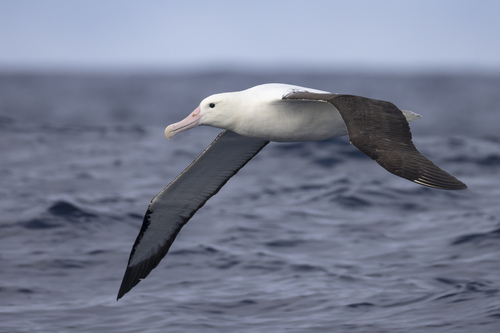
Northern Royal Albatross
Diomedea sanfordi
The Northern Royal Albatross is a true titan of the sky, boasting one of the largest wingspans of any living bird. Witness the breathtaking grace of these ocean wanderers as they master the winds of the Southern Hemisphere.
Quick Identification
Size
Wingspan of 2.7 to 3.0 meters (8.9 to 9.8 ft); body length of 115 cm (45 in); weight between 6.2 and 8.2 kg (13.7 to 18.1 lbs).
Colors
Adults feature a snow-white head, neck, and body. Unlike their southern cousins, their upper wings are almost entirely black. The bill is pale pink with a dark, prominent 'cutting edge' on the upper mandible.
Key Features
- Extensive black upper wings with minimal white mottling
- Pale pink bill with a signature black line along the cutting edge
- Massive wingspan reaching nearly 10 feet
- White head and underparts even in juvenile stages
When You’ll See Them
Behavior
The Northern Royal Albatross, known locally as Toroa, is a marathon traveler of the open ocean. These birds spend the vast majority of their lives at sea, utilizing a flight technique called dynamic soaring that allows them to travel thousands of miles with minimal wing flapping. They are monogamous and typically mate for life, returning to land only to breed every two years. Their social interactions are complex, often involving 'gamming'—a behavior where groups of young birds congregate to vocalize, snap their bills, and spread their wings in dramatic displays.
When nesting, they are surprisingly docile but highly protective of their single egg. They have a slow life cycle, with chicks taking roughly eight months to fledge. While they generally avoid human contact, they have become an icon of eco-tourism in New Zealand, where the only mainland colony in the world exists. They are remarkably long-lived, with some individuals reaching over 60 years of age, maintaining the same nesting territory for decades.
EverydayEarth exclusive
Camera Tips
Capturing a Northern Royal Albatross on a trail camera requires a specialized approach due to their coastal habitat and massive scale. If you are lucky enough to live near a flight path or a cliffside viewing area, position your camera at a height of 3 to 5 feet, angled slightly upward toward the horizon. Because of their nearly 10-foot wingspan, a wide-angle lens is essential; otherwise, you may only capture a blur of white feathers rather than the full bird.
Setting your trigger speed to its fastest possible setting (0.2 seconds or less) is critical. These birds can glide past a lens at high speeds, and a slow trigger will result in 'empty' frames. For the best shots, place cameras near known 'take-off' ramps—sloped, grassy areas where the birds run to catch the wind. Avoid using flash at night, as this can disorient the birds; instead, rely on high-quality infrared sensors or high-ISO daytime settings to capture the crisp contrast of their black wings against the sky.
Standard baiting is not recommended for albatrosses as they are protected species and should never be encouraged to land in domestic environments. However, if you are monitoring a coastal property, the best 'lure' is simply a windy day. Set your camera to burst mode (3-5 photos per trigger) during south-westerly winds, which provide the lift these birds need to soar close to shorelines. Ensure your camera housing is salt-rated or protected by a weather shield, as sea spray can quickly corrode standard trail camera electronics.
Similar Species
Species that look similar or are commonly confused with Northern Royal Albatross.
Frequently Asked Questions
Record Northern Royal Albatross at your habitat
Connect a camera to start building your own species record — AI identifies every visitor automatically.