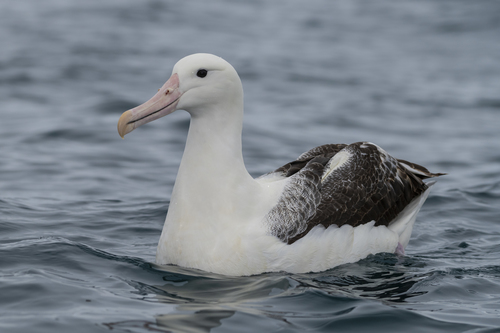
Southern Royal Albatross
Diomedea epomophora
The Southern Royal Albatross is a magnificent giant of the sea, boasting one of the largest wingspans in the avian world. Watching this 'toroa' glide effortlessly over the Southern Ocean is a breathtaking encounter with one of nature's greatest navigators.
Quick Identification
Size
Length: 112–123 cm (44–48 in); Wingspan: 2.9–3.3 m (9.5–10.8 ft); Weight: 8.5–10.3 kg (18.7–22.7 lbs)
Colors
Pure white body and head; black upper wings that whiten with age from the leading edge; pale pink bill with a black cutting edge.
Key Features
- Massive wingspan often exceeding 3 meters
- Thin black line along the cutting edge of the upper mandible
- White 'elbow' patches on the leading edge of the wings
- Large, bulbous head profile
When You’ll See Them
Behavior
The Southern Royal Albatross is a true nomad of the Southern Ocean, spending the vast majority of its life on the wing. These birds are masters of dynamic soaring, a flight technique that allows them to travel thousands of miles with minimal effort by harnessing the wind gradients above the waves. They are largely solitary at sea but become highly social when returning to their breeding colonies on subantarctic islands. Because they take nearly a year to raise a single chick, they typically breed only once every two years.
When interacting with humans, they are often seen following fishing vessels to scavenge for scraps. On land, their behavior is characterized by elaborate social displays, including 'gamming' where groups of young birds gather to hoot, snap their bills, and spread their massive wings to establish social hierarchies and find future mates. Despite their size, they are surprisingly gentle, though they will defend their nesting sites with bill-clattering if approached too closely.
EverydayEarth exclusive
Camera Tips
Capturing a Southern Royal Albatross on a trail camera is a unique challenge because they are rarely found in traditional 'backyards' unless you live on a coastal bluff in New Zealand or near their subantarctic breeding grounds. For coastal property owners, the best strategy is to place cameras on high vantage points overlooking the ocean. Position your camera facing away from the direct sun to avoid glare off the water, and use a wide-angle lens if possible to capture the full scale of their nearly 11-foot wingspan as they glide past.
Salt spray is the biggest enemy of electronics in these environments. If you are setting up a camera near a cliff edge, use a dedicated waterproof housing and wipe the lens with a microfiber cloth frequently. Because these birds move incredibly fast when catching an updraft, you must set your camera to its fastest possible trigger speed. A delay of even half a second might result in a photo of an empty sky or just the tip of a wing.
In terms of settings, use a 'Burst' or 'Multi-shot' mode. Setting the camera to take 3-5 photos per trigger event significantly increases your chances of getting a clear shot of the bird's head and bill, which are essential for identification. High-speed video (60fps or higher) is also an excellent choice, as it allows you to see the incredible mechanics of their flight in slow motion. If you are near a known flyway, dawn and dusk provide the most dramatic lighting, but ensure your ISO is high enough to keep the shutter speed fast enough to freeze the motion.
Similar Species
Species that look similar or are commonly confused with Southern Royal Albatross.
Frequently Asked Questions
Record Southern Royal Albatross at your habitat
Connect a camera to start building your own species record — AI identifies every visitor automatically.